System Prompt Security: Not an Access Control
Learn how to secure AI system prompts without treating them as secrets or access controls. Covers leakage, authorization, testing, and change management.
A system prompt is a set of instructions that helps define an AI application's role, behaviour, limits, and response style. It may tell the model which tasks to perform, which topics to refuse, how to use tools, and how to format an answer.
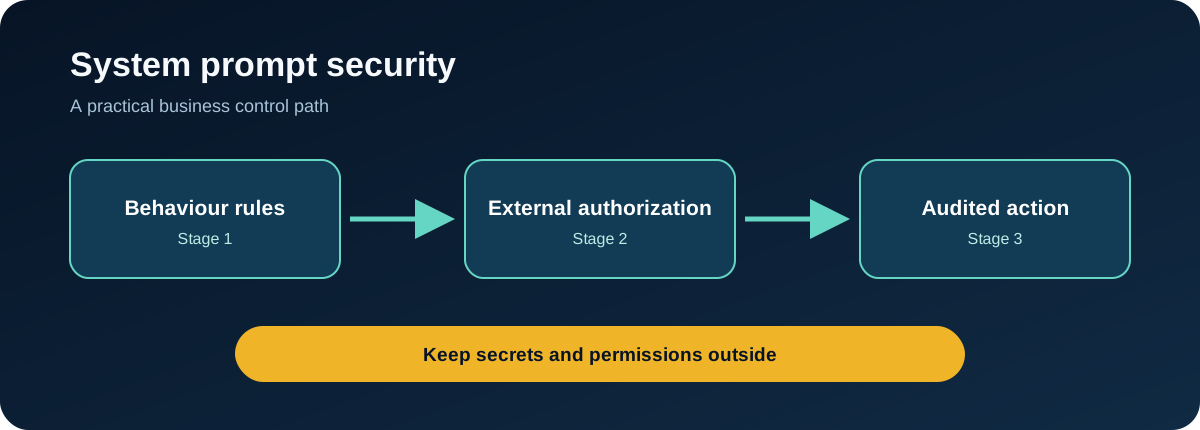
System prompts are useful guardrails, but they are not reliable access controls. They can be exposed, ignored, misunderstood, or displaced by other content. A secure design assumes that the prompt may eventually be seen.
What a system prompt should do
A system prompt can:
- define the approved business purpose
- identify the intended user and audience
- set response boundaries
- explain how to treat untrusted content
- require citations or uncertainty statements
- direct the model to request approval before certain steps
- establish a safe refusal pattern
These instructions can improve consistency. They should support controls enforced elsewhere in the application.
What a system prompt should never contain
Do not place passwords, API keys, tokens, connection strings, private encryption material, or other credentials in a system prompt. Do not assume that marking instructions as hidden makes them confidential.
OWASP states that system prompts should not be treated as secrets or used as security controls. It recommends keeping credentials out of prompts and enforcing authorization independently. OWASP
The same rule applies to sensitive internal details. Avoid including information that would cause material harm if a user extracted or inferred it.
Prompt rules cannot enforce permission
An instruction such as "only managers may access payroll" does not verify that the current user is a manager. The application must check identity and authorization before retrieving the data or allowing the action.
Keep these controls outside the model:
- user authentication
- role and resource permissions
- tool allowlists
- transaction limits
- client or tenant separation
- human approval gates
- audit logging
AWS recommends designing for eventual system-prompt leakage and using external controls to reduce the resulting impact. AWS Security Blog
Manage prompts like controlled configuration
A system prompt can materially change how an application behaves. Treat it as a versioned business control rather than informal text.
Record:
- the prompt owner
- the approved purpose
- the current version
- who changed it and why
- the test results
- the release date
- the rollback process
Changes should be reviewed when they affect data access, tool use, refusals, client communication, or higher-consequence decisions.
Test for more than exact phrases
Attackers and curious users do not always ask, "show me your system prompt." They may request summaries, translations, encoded versions, partial repetition, role-play, or multi-step reconstruction.
OWASP's prompt-injection guidance describes direct, indirect, encoded, multi-turn, and multimodal techniques. OWASP
Testing should confirm that:
- sensitive values are absent from the prompt
- the application still enforces access if instructions leak
- untrusted documents cannot override tool permissions
- refusals remain appropriate across paraphrased attacks
- prompt changes do not break existing safeguards
- unusual failures create useful logs and alerts
A practical design pattern
Use the system prompt to describe intended behaviour. Use the application to authenticate users, authorize data, restrict tools, require approval, and record actions. Use output checks to detect sensitive content and policy violations. Then test the full workflow with normal and adversarial inputs.
This layered approach accepts a basic reality: natural-language instructions can guide a model, but they cannot guarantee that the model will enforce a security decision.
Leadership questions
- Does any system prompt contain a secret or restricted internal detail?
- Which controls still work if the full prompt becomes public?
- Who approves changes to prompts used in production?
- Are prompt versions tied to testing and release records?
- Can the team reconstruct which prompt governed a disputed output?
The strongest system prompt is not the one nobody can discover. It is the one that helps the AI behave consistently while the real security controls remain enforceable outside it.
FAQ
Why does system prompt security matter to a business?
System prompts often describe workflow rules, internal logic, and tool behaviour. If they also contain secrets or act as the only permission layer, prompt leakage or manipulation can expose information and turn a model error into unauthorized access.
Who should own this control?
The product or workflow owner should own behavioural requirements. Application and security teams should keep identity, authorization, secrets, and transaction approval in deterministic systems outside the prompt.
What is the first practical step?
Inspect one production system prompt for credentials, connection details, role definitions, or permission rules. Move those controls into protected configuration and application authorization, then test whether a changed or disclosed prompt can alter access.
Put this control into practice
Start with one AI workflow that handles sensitive, operational, or client information. Document its policy rules, output boundaries, and accountable review. Test the process with a normal request, an unsafe request, and an error case before expanding its use.
QuantM helps Canadian SMBs connect AI governance with identity, Microsoft 365, cybersecurity, and documented business controls. If your team needs a practical baseline, an AI and Cyber Governance Diagnostic can identify the first control gaps to address.
Related AI security guides
- Prompt Jailbreaking: What It Means for Business AI Security
- What Is Prompt Injection? A Business Guide to Protecting AI Workflows
- Least Privilege for AI Agents: Give Access by Task, Not Convenience
- Constitutional AI Explained: Principles, Training, and Business Limits
- ChatGPT Security for Business: Control Checklist