AI Data Provenance and Lineage: Build the Trail
Learn how AI data provenance and lineage track source, ownership, changes, retrieval, outputs, and actions across a business AI workflow.
AI data provenance records where information came from, who created or supplied it, and how it has changed. Data lineage shows how that information moved and was transformed across systems, from source to AI-assisted output or action.
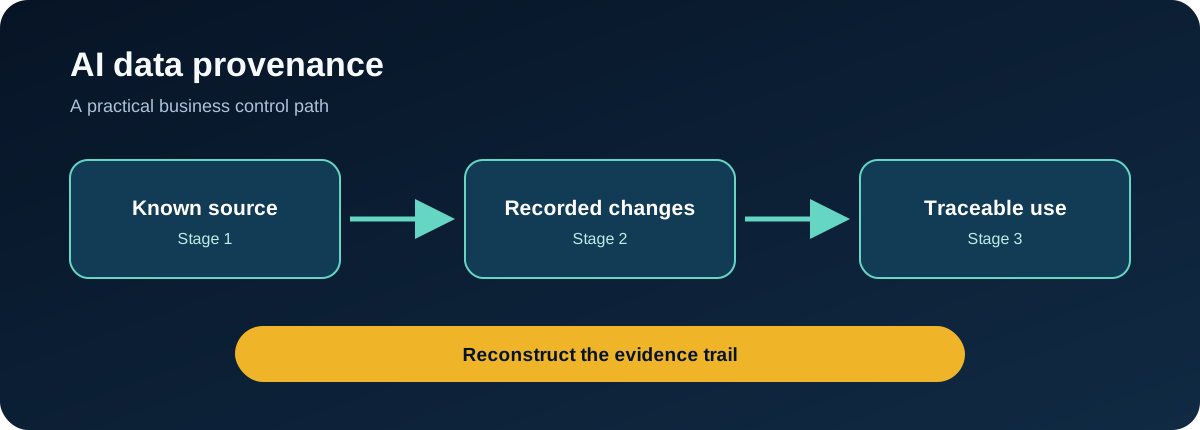
Together, they help a business answer a practical question: can we reconstruct what information influenced this result?
Why AI makes traceability harder
A traditional report may have a visible source file and author. An AI-generated answer can combine:
- a user's prompt
- earlier conversation history
- an uploaded document
- several retrieved passages
- a third-party model
- a system-prompt version
- tool results
- human edits after generation
Without a traceable record, it can be difficult to verify an answer, correct a bad source, investigate exposure, or explain a disputed action.
NIST defines provenance as the historical, attributed, and documented record of a data asset, including its origin and alterations. NIST
What to record
The required evidence depends on the use case and data sensitivity. A useful minimum can include:
- source system and document identifier
- source owner and approved audience
- date created, changed, indexed, and deleted
- data classification and retention rule
- transformation or redaction steps
- retrieval time and user identity
- model, application, and prompt version
- output and cited sources
- tool calls and approvals
- reviewer changes and final disposition
Do not collect logs without considering privacy and security. Evidence should be protected, retained for a defined period, and accessible only to people with a legitimate need.
Provenance for RAG and knowledge assistants
In a retrieval-augmented generation system, provenance should begin before indexing. Each approved repository needs an owner, audience, update process, and deletion path.
When the AI answers a question, the business should be able to identify which passages were retrieved and whether the user had permission to access them. A citation is helpful only if it points to the correct source and that source actually supports the claim.
If a document is wrong or malicious, provenance helps the team locate where it entered the system, which outputs it influenced, and what must be corrected.
Start with high-consequence workflows
Not every draft needs the same evidence. Prioritize workflows where an AI output may affect:
- a client deliverable
- a legal, financial, HR, or security decision
- personal or confidential information
- an automated system action
- a regulated or contractual obligation
For each workflow, define the decision that must be explainable and work backward to the evidence required.
A practical implementation sequence
1. Inventory the workflow
Map data sources, users, models, prompts, retrieval systems, tools, outputs, and review steps.
2. Assign owners
Name an owner for each source and for the AI-assisted process. Ownership should include approval, correction, retention, and incident responsibilities.
3. Create stable identifiers
Use document, dataset, model, prompt, and transaction identifiers so evidence can be connected without relying on filenames or memory.
4. Capture changes
Record material changes to source data, prompts, models, permissions, and tools. Keep enough history to explain past results after the system changes.
5. Test reconstruction
Select a past output and try to reproduce its evidence path. If the team cannot identify the user, source, version, review, and action, the lineage is incomplete.
Questions for leadership
- Which AI-assisted decisions must the business be able to explain?
- Can an owner correct or remove a bad source?
- Are client and department data flows separated?
- Can the team identify which outputs used a compromised document?
- Are logs protected and retained appropriately?
- Who reviews lineage when a workflow changes?
Provenance and lineage are not documentation for its own sake. They provide the evidence needed to trust, correct, and govern AI-assisted work.
FAQ
Why does AI data provenance and lineage matter to a business?
Without provenance, a reviewer may see an AI answer but be unable to identify the source records, transformations, permissions, or model context behind it. That weakens investigations, correction, client assurance, and accountable decision-making.
Who should own this control?
The data owner should be accountable for source quality and permitted use. The workflow owner should preserve lineage through ingestion and retrieval. IT and security should protect the records and investigate gaps or tampering.
What is the first practical step?
Select one important output and work backward. Identify the exact source version, ingestion event, transformation, retrieval result, model or service version, reviewer, and downstream use. Any missing step is a concrete provenance gap.
Put this control into practice
Start with one AI workflow that handles sensitive, operational, or client information. Document its source permissions, retrieval boundaries, and access evidence. Test the process with a normal request, an unsafe request, and an error case before expanding its use.
QuantM helps Canadian SMBs connect AI governance with identity, Microsoft 365, cybersecurity, and documented business controls. If your team needs a practical baseline, an AI and Cyber Governance Diagnostic can identify the first control gaps to address.
Related AI security guides
- RAG Security: How to Protect the Documents Behind Business AI
- Vector Database Security: Protecting the Data Behind AI Search
- AI Model Integrity Verification: Proving the Right Model Is Running
- AI Model Explainability: What a Business Should Be Able to Explain