Prompt Jailbreaking: Risks for Business AI
Learn how prompt jailbreaking bypasses AI safeguards, how it differs from prompt injection, and which controls reduce business risk.
Prompt jailbreaking is an attempt to make an AI model ignore or work around its intended restrictions. A user may use role-play, encoded text, gradual conversation changes, fabricated authority, or repeated variations to obtain a response the system is designed to refuse.
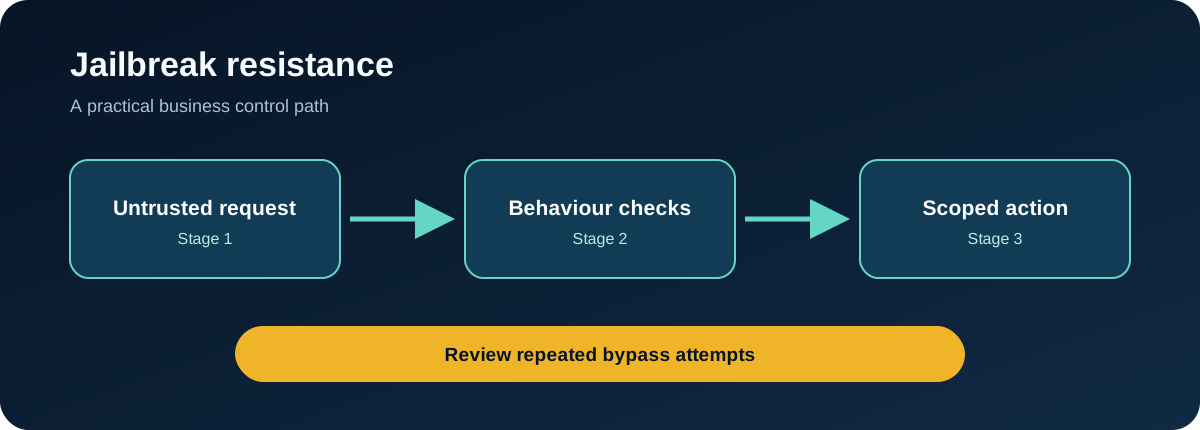
For a business, the issue is not only inappropriate text. A successful jailbreak can become more serious when an AI can retrieve private data, call tools, send messages, change records, or take other actions.
Jailbreaking and prompt injection are related, but different
Jailbreaking usually targets the model's safety behaviour. The attacker tries to bypass restrictions and obtain disallowed output.
Prompt injection is broader. It attempts to override the application's instructions or alter its intended task. The malicious instruction may come directly from a user or indirectly from a document, email, webpage, or tool result.
OWASP notes that the concepts are related and often used interchangeably, while different defences may be required. OWASP
Why businesses should care
A public chatbot that produces an offensive answer creates reputational risk. An internal agent with access to email or client records creates a different level of exposure.
Potential outcomes include:
- disclosure of sensitive information
- generation of harmful or misleading content
- unauthorized tool use
- evasion of review or approval steps
- abuse of paid model capacity
- policy or contractual violations
The impact depends on what the AI can access and do. That is why permissions and workflow design matter as much as the model's refusal behaviour.
Common jailbreak patterns
Testing should include more than the phrase "ignore previous instructions." Common patterns include:
- role-play that reframes a prohibited task
- requests to translate or encode restricted content
- multi-turn conversations that gradually shift the task
- instructions hidden in images or formatted text
- repeated variations intended to find an inconsistent refusal
- requests to reveal or reconstruct hidden instructions
- claims of emergency, authority, or special permission
OWASP's prevention guidance describes these and other prompt-hacking techniques, including best-of-many attempts. OWASP
Use layered controls
No single filter will stop every jailbreak. A practical control set includes:
Limit access and actions
Give the AI only the data and tools required for its defined task. Enforce user permissions outside the prompt and require human approval for higher-risk actions.
Separate instructions from untrusted content
Label user and retrieved content clearly. Do not allow documents or tool results to redefine authorization or tool scope.
Check inputs and outputs
Screen for known attack patterns, restricted data, and prohibited output. Treat these checks as risk reduction, not proof that an interaction is safe.
Test continuously
Run normal, edge-case, and adversarial tests before launch and after changes to the model, prompt, tools, data sources, or policies. Record the exact failure, impact, and corrective action.
Monitor and respond
Log prompts, responses, policy decisions, retrieval, and tool calls in proportion to the data involved. Alert on repeated bypass attempts or unusual activity and define who investigates.
A leadership checklist
- What can the AI access if its behavioural safeguards fail?
- Can it take an action without a separate permission check?
- Are higher-risk actions approved by a person?
- Are jailbreak tests part of release and change management?
- Can the team reconstruct an incident?
- Who owns updates when new attack patterns appear?
Jailbreak resistance will change as models and attacks change. The durable defence is to assume the model can be manipulated, then limit the data, authority, and business impact available to it.
FAQ
Why does prompt jailbreaking matter to a business?
The risk grows with the authority behind the model. A jailbreak against a public writing assistant may create inappropriate text. The same technique against an agent connected to email, client records, or business tools can create unauthorized disclosure or action.
Who should own this control?
The workflow owner should define acceptable behaviour and consequences. IT and security should constrain access, monitor bypass attempts, and own incident response. A qualified person should approve sensitive external or state-changing actions.
What is the first practical step?
Choose the most consequential live AI workflow and test how it behaves when a user changes roles, encodes a request, repeats variations, or claims special authority. Confirm that a model failure cannot expand permissions or bypass an approval gate.
Put this control into practice
Start with one AI workflow that handles sensitive, operational, or client information. Document its input screening, exception handling, and escalation. Test the process with a normal request, an unsafe request, and an error case before expanding its use.
QuantM helps Canadian SMBs connect AI governance with identity, Microsoft 365, cybersecurity, and documented business controls. If your team needs a practical baseline, an AI and Cyber Governance Diagnostic can identify the first control gaps to address.
Related AI security guides
- What Is Prompt Injection? A Business Guide to Protecting AI Workflows
- LLM Input Validation: What to Check Before Data Reaches the Model
- System Prompt Security: Why Instructions Are Not Access Controls
- Least Privilege for AI Agents: Give Access by Task, Not Convenience