Constitutional AI Explained: Limits for Business
Learn how Constitutional AI uses written principles and AI feedback to shape model behaviour, plus what businesses still need to control.
Constitutional AI is a model-training approach developed by Anthropic. It uses a written set of principles, called a constitution, to guide how an AI system critiques, revises, and learns from responses. The term does not mean that a model automatically understands or complies with a country’s constitutional law.
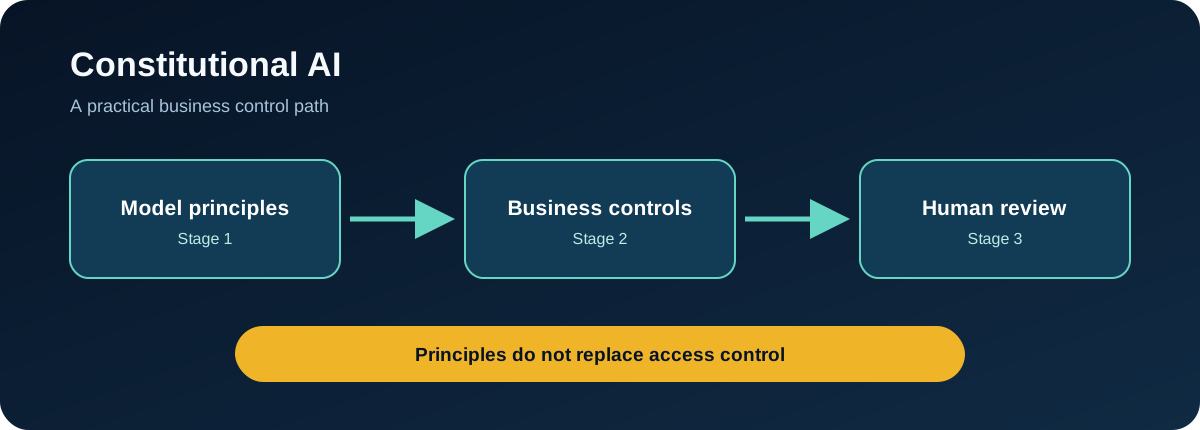
For businesses, the key lesson is useful but limited: explicit behavioural principles can make model goals easier to inspect, yet they do not replace deployment controls or human accountability.
How does Constitutional AI work?
Anthropic’s published method uses a constitution during two broad stages.
Critique and revision
The model produces a response, evaluates that response against a selected principle, and revises it. These examples are used to improve behaviour through supervised learning.
Reinforcement learning from AI feedback
The system compares responses using constitutional principles and generates preference signals. Those AI-generated preferences support reinforcement learning, reducing the amount of direct human labelling needed for certain behaviours.
The method is closely associated with reinforcement learning from AI feedback, or RLAIF. The constitution provides the criteria used for that feedback.
What is in an AI constitution?
A constitution is a set of written principles about desired behaviour. Anthropic has published principles concerning helpfulness, honesty, harm, rights, safety, and other normative considerations.
The selection and wording of principles matter. They determine what the model is asked to consider, but they do not guarantee perfect interpretation or consistent behaviour in every context.
Potential benefits
More explicit behavioural goals
Written principles are easier to inspect and discuss than values that exist only through a large collection of human preference labels.
Scalable feedback
AI-generated critiques and comparisons can support model training without requiring a person to review every example.
Faster revision
A provider can update or study principles and evaluate how those changes affect model behaviour.
These are properties of a training approach, not proof that a deployed application is safe for every use.
What Constitutional AI does not solve
Business-specific policy
A general model constitution does not know your client contracts, approval limits, retention rules, or internal escalation paths.
Access control
Behavioural training cannot substitute for identity, least privilege, tenant isolation, or secure credential handling.
Factual accuracy
A model can follow behavioural principles and still produce an incorrect or unsupported answer.
Tool authority
An agent may have access to email, files, code, or transactions. High-impact actions still need permission checks, limits, and human approval.
Legal compliance
A provider’s constitution is not a legal determination. Applicable duties depend on the use case, data, sector, and jurisdiction.
Questions buyers should ask
- Are the model’s governing principles published or described?
- How are the principles used in training and evaluation?
- How does the provider test conflicts between helpfulness and safety?
- What behaviour can the customer configure?
- How are model changes communicated?
- What controls exist outside the model?
- Can the customer evaluate the model against its own policies?
- Which decisions remain the customer’s responsibility?
Applying the idea inside a business
A company does not need to train a foundation model to benefit from explicit principles. It can create a short, approved behavioural specification for each AI use case:
- State the system’s purpose.
- Define priority principles and prohibited behaviour.
- Add examples for ambiguous or conflicting situations.
- Enforce data and tool boundaries technically.
- Test the principles using representative and adversarial cases.
- Record failures and update the specification.
This is not identical to Anthropic’s training method, but it applies the useful governance idea: make expectations visible and testable.
FAQ
Is Constitutional AI about constitutional law?
No. In this context, “constitution” means a set of principles used to guide model training and behaviour. It does not automatically establish legal compliance.
Is Constitutional AI the same as RLAIF?
They are closely related. Anthropic’s Constitutional AI method uses AI-generated feedback based on constitutional principles during reinforcement learning.
Can a business create its own AI constitution?
A business can create a behavioural policy or model specification for its applications. Whether it can use a custom constitution in model training depends on the provider, model, and technical approach.
Treat principles as one control layer
Review the model provider’s principles, then compare them with your own obligations. Fill the gaps with access restrictions, approved data, output checks, evaluation, monitoring, and human review.
Put this control into practice
Start with one AI workflow that handles sensitive, operational, or client information. Document its policy rules, output boundaries, and accountable review. Test the process with a normal request, an unsafe request, and an error case before expanding its use.
QuantM helps Canadian SMBs connect AI governance with identity, Microsoft 365, cybersecurity, and documented business controls. If your team needs a practical baseline, an AI and Cyber Governance Diagnostic can identify the first control gaps to address.
Related AI security guides
- AI Alignment for Business: Turning Intent Into Verifiable Controls
- System Prompt Security: Why Instructions Are Not Access Controls
- AI Model Explainability: What a Business Should Be Able to Explain
- AI Robustness Testing: Will the System Behave Safely When Conditions Change?