AI Model Explainability for Business
Learn what AI explainability means in practice, including purpose, data, limitations, controls, review, and evidence for business decisions.
AI model explainability is the ability to give an appropriate account of how an AI-assisted result was produced and how it should be used. The right explanation depends on the audience and consequence.
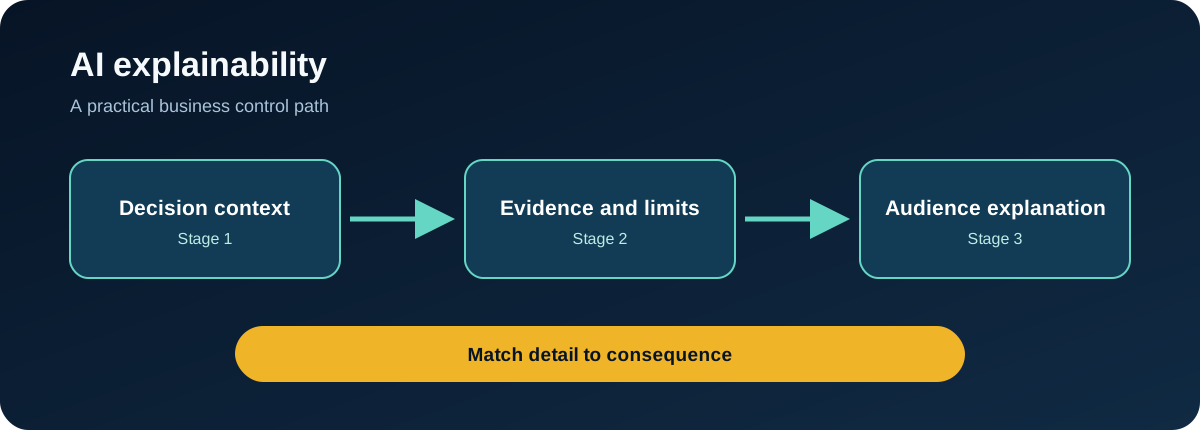
A data scientist may need technical detail. A client, manager, employee, or investigator may need a clear account of the system's purpose, information sources, limitations, controls, and human oversight.
Explain the system, not only the model
Business outcomes rarely come from a model alone. They may involve prompts, retrieved documents, third-party services, business rules, tool calls, and human review.
A useful explanation should cover:
- the task the system is designed to support
- the information it can access
- the model and provider involved
- the rules and constraints applied
- known limitations and failure modes
- whether a person reviewed the result
- how the result influenced a decision or action
NIST treats explainability and interpretability as characteristics of trustworthy and responsible AI, supported by research and measurement. NIST's four principles of explainable AI
Match the explanation to the audience
Users
Users need to know what the AI can do, what information they may provide, when an answer may be unreliable, and when to escalate.
Reviewers and managers
Reviewers need the input, relevant sources, output, confidence or uncertainty where available, applicable policy, and the criteria used to accept or reject the result.
Clients and affected people
They may need a plain-language explanation of the AI's role, the information considered, material limitations, and how to request human review or correction.
Security and incident teams
Investigators need model and prompt versions, logs, access decisions, retrieved sources, tool calls, approvals, and changes.
One generic explanation will not serve every need.
Do not confuse confidence with evidence
A fluent answer can sound certain without being correct. An AI-generated explanation can also be plausible without accurately describing the model's internal process.
Build explanations from evidence the system actually records:
- approved source citations
- versioned configuration
- access and retrieval logs
- validation results
- reviewer decisions
- tool execution records
Avoid presenting generated reasoning text as a guaranteed account of why a model produced an output.
Set explanation requirements before deployment
For each use case, ask:
- Who may be affected by the output?
- What decision or action could follow?
- What would a reviewer need to verify it?
- What must the business reconstruct after an incident?
- What explanation must be given to a client or user?
Higher-consequence workflows generally need stronger documentation, source traceability, independent review, and a clear route to challenge or correct a result.
NIST's broader AI governance work connects technical practices such as explainability with organizational risk management. NIST
A practical explainability record
For a material AI-assisted decision, retain an appropriate record of:
- business purpose and owner
- input and data classification
- sources retrieved
- system and prompt version
- output and validation results
- known limitations
- human reviewer and decision
- resulting action
- correction or appeal path
Protect this record according to its sensitivity and retention requirement.
Leadership questions
- Can we explain where an AI-assisted answer came from?
- Are explanations based on recorded evidence?
- Do users know the system's limits?
- Can a person challenge or correct a higher-consequence result?
- Can investigators reproduce the relevant configuration and sources?
- Is someone accountable for the final business decision?
Explainability does not require every person to understand every mathematical detail. It requires the business to communicate enough accurate, audience-appropriate evidence for responsible use, review, and accountability.
FAQ
Why does AI model explainability matter to a business?
People need enough information to challenge an output, correct an error, and understand the limits of a decision. The required explanation becomes more demanding when the system affects a client, employee, financial commitment, or regulated process.
Who should own this control?
The business owner should define what each audience must understand. Data and technical owners should provide the evidence, while legal, compliance, security, or subject-matter reviewers should validate explanations for higher-consequence uses.
What is the first practical step?
Take one material AI-assisted decision and write separate explanations for its user, reviewer, affected client, and incident team. If the team cannot name the data, rules, limitations, review path, and correction process, the explanation is incomplete.
Put this control into practice
Start with one AI workflow that handles sensitive, operational, or client information. Document its fact checks, data review, and release approval. Test the process with a normal request, an unsafe request, and an error case before expanding its use.
QuantM helps Canadian SMBs connect AI governance with identity, Microsoft 365, cybersecurity, and documented business controls. If your team needs a practical baseline, an AI and Cyber Governance Diagnostic can identify the first control gaps to address.
Related AI security guides
- AI Output Validation: What to Check Before AI-Generated Work Leaves the Business
- AI Hallucinations in Business: Reducing Confidently Wrong Answers
- Constitutional AI Explained: Principles, Training, and Business Limits
- Concept Drift Monitoring: Keeping AI Reliable After Launch