Ransomware in Manufacturing: Risks & Protections
Plan ransomware protection for manufacturing around IT and OT boundaries, safe production states, vendor access, dependencies, and controlled restart.
To discuss how Ransomware in Manufacturing: Risks & Protections applies to your systems and responsibilities, contact QuantM Technologies for a scoped conversation.
Manufacturing risk priorities
- OT systems (PLCs, SCADA, HMIs) often run legacy software that cannot be patched or updated
- IT/OT convergence creates new attack paths, compromising IT systems can now halt production lines
- Air-gapping OT networks and implementing MDR monitoring across both IT and OT are critical defenses
Why manufacturing recovery is different
Manufacturing companies face a unique ransomware risk profile. Unlike office-based businesses where ransomware means employees cannot access files, in manufacturing ransomware means production lines stop running, orders go unfulfilled, supply chains break, and revenue evaporates by the hour. Attackers know this, which is why they disproportionately target manufacturers.
The convergence of Information Technology (IT) and Operational Technology (OT) has expanded the attack surface. Modern factories connect PLCs, SCADA systems, and industrial IoT devices to corporate networks for monitoring and efficiency. This connectivity means a phishing email targeting an office worker can ultimately halt a production line.
Production risks to account for
Legacy OT vulnerability. Manufacturing environments typically include operational technology systems running Windows XP, Windows 7, or proprietary operating systems that have not received security updates in years, and cannot be updated without risking production stability. These systems were designed for reliability and safety, not cybersecurity. They lack authentication, encryption, and monitoring capabilities that are standard in modern IT systems.
IT/OT convergence risk. As manufacturers connect OT systems to IT networks for monitoring, analytics, and remote management, they create attack paths from the corporate email system to the factory floor. An attacker who compromises a single IT workstation can potentially reach SCADA systems, PLCs, and production controllers.
Supply chain dependencies. A ransomware interruption at one manufacturer can affect customers, suppliers, and logistics partners. Map those dependencies so continuity priorities reflect committed deliveries, available inventory, alternate production, and communication duties.
Protection strategies for manufacturers include network segmentation between IT and OT with strict firewall rules, unidirectional security gateways that allow data to flow from OT to IT for monitoring but prevent any traffic from IT to OT, MDR monitoring across both IT endpoints and OT network traffic, offline backups of critical production configurations and programs, incident response plans with manufacturing-specific recovery procedures, and regular tabletop exercises simulating ransomware scenarios on the production floor.
Frequently Asked Questions
Can ransomware shut down a factory?
Yes. Ransomware regularly shuts down manufacturing operations. When ransomware encrypts ERP systems, production scheduling software, quality management systems, or SCADA/HMI interfaces, production halts entirely. Even if OT systems are not directly encrypted, the loss of supporting IT systems (ordering, inventory, shipping) can force a complete production stoppage.
How do you protect OT systems from ransomware?
Protect OT systems through boundaries designed with operations and safety owners. Relevant measures can include network segmentation, tightly controlled remote access, asset records, OT-aware monitoring, removable-media procedures, and vendor-access controls. Internet and corporate-network paths should be limited to documented operational requirements, protected with appropriate controls, and reviewed for unintended reachability. A change that is safe in office IT may require additional testing before it is applied to production equipment.
Protect production without treating OT like office IT
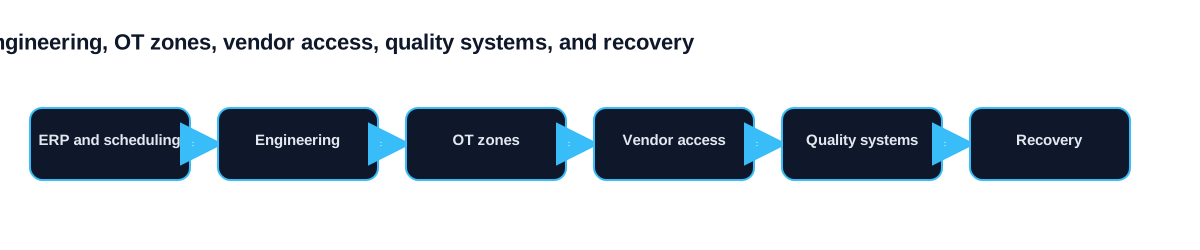
Manufacturing ransomware planning starts with the production process, not a generic asset list. Map engineering workstations, plant-floor interfaces, historians, ERP, scheduling, vendor access, and recovery dependencies to the products they support. Operations and safety owners should define which containment choices are acceptable before technical responders need to act.
Establish ownership and evidence
Plant operations, safety, OT engineering, IT, and key vendors need a shared view of production dependencies and authority. Record the equipment or service affected, the approved change window, the safe containment option, the recovery dependency, and the alternate contact. Evidence may include access records, network paths, tested images, vendor procedures, and production validation.
Set the assessment boundary before testing. At minimum, include safe isolation boundaries and manual operating procedures. Dependencies deserve the same attention as the main application. A service may be technically restored yet remain unusable because identity, DNS, network access, encryption keys, or a third-party connection is unavailable.
Measure the result without inventing precision
For one representative production service, measure the time to reach operations and safety owners, isolate the approved scope, restore required components, and complete a safe production check. Record any vendor, identity, recipe, historian, or network dependency that prevented the service from returning.
Include the production scheduling and quality teams when their records determine whether restored work can be released, traced, or reconciled with orders already in progress.
Source and next step
- Sophos manufacturing ransomware report announcement
- Canadian Centre for Cyber Security, Ransomware threat outlook 2025 to 2027
- PIPEDA section 10.1
- NIST ransomware guidance for small businesses
Document safety constraints before testing any production-control change.
Keep plant safety and process integrity ahead of speed. Cybersecurity staff should not isolate controllers, change logic or restart equipment without the plant authority responsible for safe operation. The response plan must identify that authority and an alternate before an incident.
Plan around safe production states
Manufacturing recovery cannot be reduced to restoring office files. Plant teams need to know which production cells can stop safely, which control systems depend on shared identity or network services, which vendors can connect remotely, and which recipes, drawings or quality records must be validated before production resumes.
Evidence to request
Set the first review around one production line and the systems required to schedule, operate, inspect and release its output. The plant operations and OT lead should document engineering workstations, historians, identity, remote vendors, ERP and safety procedures. That evidence shows what is in scope, who can change it and which failure would affect the business.
| Control point | Current evidence | Common gap |
|---|---|---|
| Production boundary | Current IT and OT diagram with approved conduits | A flat path allows office compromise to reach plant systems |
| Vendor access | Named sponsor, scheduled access, MFA and session record | Permanent accounts remain enabled between service visits |
| Manual operation | Approved reduced-capacity procedure and staffing needs | The workaround depends on unavailable data or labels |
| Return to production | Recipe, logic, quality and safety validation sign-off | Systems restart before process integrity is confirmed |
Run one safe test
The team should walk through isolation and clean restoration without making an unapproved change to live control equipment. Keep the test record with the scope, expected result, actual result, exceptions and named follow-up. Repeat the same test after the fix so leadership can distinguish a completed task from an assumed improvement.
Related guidance covers segmentation and traffic-control decisions, continuity planning for critical services, clean recovery design. These links give the reader a clear next step without turning this page into a second version of the pillar.
Put manufacturing ransomware resilience into operation
Test one production service with operations, IT, and OT owners present. Keep safety constraints and vendor dependencies visible throughout these steps:
- Map production and shared-service dependencies. Name the owner, scope and expected result before changing a control.
- Restrict remote vendor and cross-zone access. Record exceptions and dependencies instead of treating partial coverage as complete.
- Exercise safe shutdown and validated restart. Preserve the evidence and assign follow-up work with a retest date.
Evidence to retain
- Current IT and OT conduits should show the current scope rather than a planned future state.
- Vendor account sponsorship should identify the person or system that produced the record.
- Manual production procedure should include the date, limitation and unresolved exception.
- Quality and safety restart approval should connect the technical result to the affected business service.
Evidence for manufacturing-resilience ages. Review it after a major platform, supplier, identity, policy or staffing change. If the environment no longer matches the tested scope, mark the prior result as historical and schedule a new check.
Review questions
- Which line stops first?
- Can vendors connect outside scheduled work?
- What data is needed for manual operation?
- Who validates control logic?
- How is backlog reconciled?
Route production findings to the person who can change the affected process, equipment, vendor agreement, or network boundary. Record the safe retest condition with each finding. The Canadian SMB ransomware guide provides the wider control and recovery context without replacing the plant-specific plan.
Keep the approved production owner and safety authority visible in every retest record.
Coordinate cyber recovery with plant safety
Manufacturing recovery cannot be planned only from an IT console. Production leaders need to define which equipment can stop safely, which processes require an orderly shutdown and which checks must occur before a line restarts. Maintenance and engineering teams should identify controller dependencies, vendor access paths, recipes, calibration records and workstation images. Security teams can then design isolation and monitoring around those operating constraints.
The recovery plan should also address the boundary between corporate identity systems and the plant. If directory services, remote access or name resolution are unavailable, teams need an approved way to communicate and validate who can authorize changes. A clean backup of a server is not enough when the restored application cannot communicate with a controller or when the process state is unknown. One scoped exercise should follow a production service from detection through a safe stop, evidence preservation, system restoration, engineering validation and controlled restart. Record any step that depends on one person, one supplier or undocumented knowledge.