Role of Firewalls in Ransomware Defense
Learn where firewalls help against ransomware, where they do not, and how to test exposure, segmentation, egress controls, and management access.
To discuss how Role of Firewalls in Ransomware Defense applies to your systems and responsibilities, contact QuantM Technologies for a scoped conversation.
Next-generation firewalls (NGFWs) defend against ransomware by inspecting all network traffic for malicious payloads, blocking connections to known command-and-control servers, enforcing network segmentation that limits ransomware spread, filtering dangerous file types, and detecting lateral movement between network zones. Firewalls are a critical prevention and containment layer, but they must be properly configured and actively managed to be effective.
The firewall's role at a glance
- NGFWs inspect encrypted traffic (SSL/TLS) to detect ransomware payloads hidden in HTTPS connections
- Intrusion Prevention Systems (IPS) block exploitation of known vulnerabilities used for ransomware delivery
- Geo-blocking restricts traffic from high-risk countries where many ransomware operations originate
- Network segmentation via firewall zones limits ransomware spread to a single network segment
- Unmanaged firewalls with default configurations provide a false sense of security, active management is essential
What a firewall contributes
A firewall enforces network policy at the points where it is deployed. Depending on the product and configuration, it may restrict inbound exposure, separate network zones, control outbound destinations, identify applications, or supply events for investigation. Encrypted-traffic inspection and threat-detection features have technical, privacy, certificate, and performance requirements. A product licence does not prove that those features cover every relevant path or that alerts are reviewed.
However, a firewall is only as effective as its configuration and management. An improperly configured NGFW, or one with outdated rules and firmware, can be worse than no firewall at all because it creates a false sense of security.
Network controls and limits
Intrusion Prevention System (IPS). The IPS component of an NGFW monitors network traffic for exploitation attempts targeting known vulnerabilities, the same vulnerabilities ransomware operators use for initial access. When IPS detects an exploitation attempt (such as an attacker trying to exploit an unpatched Exchange Server or VPN appliance), it blocks the connection and alerts the security team.
Command-and-control (C2) blocking. After initial compromise, ransomware communicates with external command-and-control servers to receive instructions, download additional payloads, and exfiltrate data. NGFWs with threat intelligence integration maintain real-time databases of known C2 infrastructure and automatically block connections to these servers, disrupting the attack chain before ransomware can be deployed.
Network segmentation. Perhaps the most valuable firewall capability for ransomware defense is network segmentation. By dividing the network into isolated zones (user workstations, servers, OT systems, guest Wi-Fi) with firewall rules controlling traffic between zones, you limit the blast radius of a ransomware infection. Without segmentation, a single compromised workstation can encrypt every system on the network. With segmentation, the damage is contained to one zone.
Application control. NGFWs can enforce policies at the application level, blocking the use of unauthorized remote access tools (TeamViewer, AnyDesk), file-sharing applications, and Tor connections that ransomware operators commonly use. This reduces the attack surface by preventing the tools attackers rely on from functioning on your network.
Managed firewall services ensure your NGFW remains effective over time. This includes firmware updates and security patches, rule optimization and cleanup, log monitoring and analysis, configuration backups and disaster recovery, and regular security posture assessments. Without active management, firewall rules accumulate over time, creating gaps and conflicts that attackers exploit.
Frequently Asked Questions
Is a firewall enough to stop ransomware?
No. Firewalls are a critical prevention and containment layer but cannot stop ransomware alone. Phishing emails that bypass the firewall (delivered through legitimate email services), insider threats, and encrypted attack channels all require additional defenses. Effective ransomware protection requires firewalls combined with email security, endpoint detection (EDR/MDR), employee training, and backup solutions.
What is the difference between a basic firewall and a next-gen firewall?
Basic firewalls filter traffic based on IP addresses, ports, and protocols. Next-generation firewalls add deep packet inspection, SSL/TLS decryption, intrusion prevention, application-level control, threat intelligence integration, and sandboxing capabilities. For ransomware defense, NGFW capabilities are essential, basic firewalls cannot inspect encrypted traffic or detect sophisticated attack patterns.
How often should firewall rules be reviewed?
Firewall rules should be reviewed quarterly at minimum, with a comprehensive audit annually. Over time, rules accumulate that are no longer needed, conflict with each other, or create unintended security gaps. Managed firewall services handle this maintenance continuously.
Define the firewall's real role in ransomware defence
A firewall review should trace the paths that matter: public ingress, remote administration, internal movement, DNS, outbound traffic, and management access. Compare intended policy with current rules and observed flows. This identifies undocumented exposure and ineffective boundaries without assigning the firewall jobs that belong to identity, endpoint, email, or recovery controls.
Establish ownership and evidence
Network and cloud owners maintain enforcement points, application owners explain required flows, and monitoring staff confirm whether relevant events are reviewed. For each path, record the business purpose, source, destination, service, rule owner, approval, logging, and expiry date. Undocumented flows should become review items rather than permanent exceptions.
Set the assessment boundary before testing. At minimum, include allowed paths between users, servers, backups, management networks, and partners. Dependencies deserve the same attention as the main application. A service may be technically restored yet remain unusable because identity, DNS, network access, encryption keys, or a third-party connection is unavailable.
Measure the result without inventing precision
Count undocumented public rules, overly broad internal paths, unused remote-access routes, expired exceptions, and critical events without an investigation owner. Pair those counts with a traffic test that confirms the intended path works and the prohibited path does not.
Keep the source, destination, service, timestamp, and expected enforcement point with each test so a later reviewer can distinguish a policy failure from a test run against the wrong path.
Source and next step
- Canadian Centre for Cyber Security, Ransomware threat outlook 2025 to 2027
- PIPEDA section 10.1
- NIST ransomware guidance for small businesses
Use firewalls to enforce approved paths
A firewall contributes to ransomware defence by limiting reachable services and recording network activity. It does not inspect every identity decision, endpoint process or cloud action. The useful review asks which connections should exist between users, servers, backups, management networks and external parties, then tests whether the rules enforce that design.
Evidence to request
Set the first review around the path from a standard user device to a critical server and its management interface. The network security owner should document internet ingress, remote administration, DNS, outbound traffic, internal segmentation and cloud controls. That evidence shows what is in scope, who can change it and which failure would affect the business.
| Control point | Current evidence | Common gap |
|---|---|---|
| Internet exposure | Current services, owners, business need and protection | Unused or forgotten rules remain reachable |
| Internal movement | Zone design and least-required application paths | Broad any-to-any access defeats segmentation |
| Management access | Dedicated source, MFA, logging and change approval | Administration is reachable from ordinary user networks |
| Outbound control | DNS and egress policy with investigation workflow | Unexpected destinations are logged but never reviewed |
Run one safe test
The team should attempt an approved test connection from the wrong zone and confirm it is blocked, logged and reviewed. Keep the test record with the scope, expected result, actual result, exceptions and named follow-up. Repeat the same test after the fix so leadership can distinguish a completed task from an assumed improvement.
Related guidance covers ransomware movement paths, IT and OT segmentation needs, endpoint visibility beyond the firewall. These links give the reader a clear next step without turning this page into a second version of the pillar.
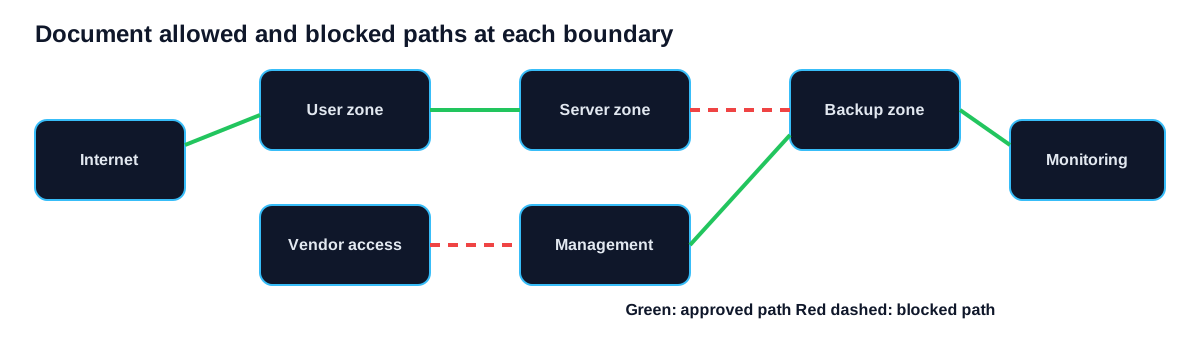
Put firewall enforcement for ransomware defence into operation
Choose one public service or internal boundary and compare its intended policy with current rules and observed traffic. Follow these steps:
- Remove unnecessary inbound services. Name the owner, scope and expected result before changing a control.
- Restrict internal and management paths. Record exceptions and dependencies instead of treating partial coverage as complete.
- Review egress and test blocked connections. Preserve the evidence and assign follow-up work with a retest date.
Evidence to retain
- Rule owner and business need should show the current scope rather than a planned future state.
- Zone and application map should identify the person or system that produced the record.
- Management source restrictions should include the date, limitation and unresolved exception.
- Blocked-flow investigation ticket should connect the technical result to the affected business service.
Evidence for network-enforcement ages. Review it after a major platform, supplier, identity, policy or staffing change. If the environment no longer matches the tested scope, mark the prior result as historical and schedule a new check.
Review questions
- Which rules lack an owner?
- Can user zones reach management?
- What vendor paths remain open?
- Who reviews outbound alerts?
- Are cloud controls included?
Remove, narrow, document, or formally accept each unexpected path. The completion record should include the approved rule and a repeatable traffic test. The ransomware protection guide places network enforcement beside identity, endpoint, email, and recovery work.
Verify management access separately
Firewall administration deserves its own test. Confirm that management interfaces are not exposed through unintended paths, privileged access uses the approved identity controls, configuration backups are protected, and emergency changes create a reviewable record. Test the alternate administrator route without weakening normal restrictions. A firewall cannot enforce policy reliably when its own management plane is reachable through an undocumented account, network, or supplier connection.