Business Continuity Planning for Ransomware
Build a ransomware continuity plan around critical services, degraded operations, manual work, suppliers, communications, recovery dependencies, and reconciliation.
To discuss how Business Continuity Planning for Ransomware applies to your systems and responsibilities, contact QuantM Technologies for a scoped conversation.
Continuity priorities
- A ransomware BCP must address extended outages (days to weeks), not just brief disruptions
- Business Impact Analysis (BIA) identifies which systems and processes are truly critical to survival
- Manual workarounds for top 5 business processes can keep revenue flowing during system recovery
- Continuity procedures need a risk-based test cadence and retesting after material systems, supplier, process, or staffing changes.
Continuity begins with business services
Some disaster recovery plans assume that infrastructure failed while trusted data and administrator access remain available. Ransomware may also affect identities, backups, management tools, and the integrity of restored data. The continuity plan should therefore include clean recovery prerequisites, alternate communications, manual work, and evidence-based return-to-service decisions.
Ransomware-specific business continuity planning addresses the unique characteristics of a ransomware event: extended outages lasting days or weeks rather than hours, uncertain scope (which systems are compromised and which are safe), data integrity questions (can restored data be trusted), and the possibility that recovery itself may trigger re-infection if the attacker's persistence mechanisms are not fully eliminated.
Continuity decisions to document
Business Impact Analysis (BIA). The foundation of any BCP is understanding which business functions are critical and how long each can be offline before causing irreversible damage. A BIA identifies every business process, maps it to the technology systems it depends on, and assigns two metrics: the Maximum Tolerable Downtime (MTD), how long the process can be down before causing existential harm to the business, and the Recovery Time Objective (RTO), how quickly you must restore the process to avoid reaching that threshold.
Manual workaround procedures. The most frequently overlooked element of ransomware BCPs is manual workaround procedures for critical business functions. If your order processing system is down for a week, can orders be taken by phone and tracked on paper? If your accounting system is encrypted, can payroll be processed manually? If your email is compromised, how do you communicate with customers? Documenting manual procedures for your top five business processes, and ensuring employees know how to execute them, can mean the difference between degraded operations and complete shutdown.
Communication planning. Ransomware creates a communication crisis alongside an operational one. Your BCP should define pre-drafted communication templates for employees (what happened, what to do, what not to do), customers (service impact, data exposure status, remediation timeline), partners and vendors (operational impact, alternative contact methods), regulators (breach notification, compliance status), and media (if the incident becomes public). Assign specific individuals to each communication channel before an incident occurs. During a crisis, communication delays and conflicting messages compound the damage.
Testing through tabletop exercises. A BCP that has never been tested is a document, not a plan. Tabletop exercises simulate a ransomware scenario and walk the response team through each phase of the BCP. These exercises reveal gaps that are invisible on paper: the IT director's personal cell phone is the only way to reach the backup vendor after hours, but no one else has the number. The manual payroll procedure references a form that was discontinued two years ago. The communication plan assumes email access, which will not be available during a ransomware attack.
Frequently Asked Questions
How is a ransomware BCP different from a standard disaster recovery plan?
A ransomware BCP addresses threats unique to ransomware: simultaneous encryption across all locations (not localized damage), compromised backups, uncertain scope of compromise, extended recovery timelines (weeks not hours), active adversary who may interfere with recovery, legal and regulatory obligations specific to data breaches, and the possibility of re-infection during recovery. Standard DR plans assume infrastructure damage with intact data, the opposite of ransomware.
How often should business continuity plans be tested?
Set tabletop, workaround, communication, and technical recovery tests according to business criticality, change, and unresolved risk. Review the plan after exercises, material infrastructure or supplier changes, and actual incidents. Retest failed conditions instead of relying on a fixed calendar alone.
Can an MSSP help with business continuity planning?
Yes. MSSPs with ransomware expertise can conduct Business Impact Analyses, develop recovery prioritization tiers, create incident response and communication plans, facilitate tabletop exercises, and maintain the technical recovery capabilities (backups, MDR, response procedures) that the BCP depends on. Outsourcing BCP development and testing to an MSSP ensures it reflects current threat intelligence and is maintained continuously rather than created once and forgotten.
Connect ransomware response to business continuity
A continuity plan begins with the minimum service the business must deliver during disruption. Define staffing, manual workarounds, customer and supplier communication, alternate technology, maximum duration, and restoration dependencies for that service. This keeps continuity work separate from the technical response plan while connecting the decisions that each team needs from the other.
Define scope, owners, and proof
Include operations, leadership, IT, security, facilities, communications, finance, and key vendors. Assign one accountable owner and an alternate to each decision. Set the boundary around maximum tolerable outage, recovery priorities, alternate procedures, and return-to-normal criteria. Record exclusions so leadership can see what the assessment does not prove.
Measure what the exercise establishes
One useful measure for this subject is time to operate one critical service through an exercised workaround. Pair it with control coverage, age of open exceptions, time to reach decision-makers, restore success, and the percentage of remediation items closed by their due dates. Measures need definitions. For example, “response time” may mean alert acknowledgement, analyst investigation, customer escalation, containment, or full recovery. Those are different clocks.
Source and visual plan
- Canadian Centre for Cyber Security business continuity guidance
- Canadian Centre for Cyber Security, Ransomware playbook
- Canadian Centre for Cyber Security, Ransomware threat outlook 2025 to 2027
- PIPEDA section 10.1
Plan continuity by business service
A ransomware continuity plan should describe how priority services operate when normal identity, email, file storage or applications are unavailable. Service owners decide the minimum acceptable output, required people, manual procedure, supplier support and criteria for returning to normal operation.
The business continuity lead can begin with one service whose interruption would stop revenue, safety, payroll or a contractual commitment. The review should include maximum tolerable outage, minimum staffing, data needs, suppliers, communications and restoration order. Keeping that boundary visible helps participants distinguish a demonstrated result from an assumption about the wider environment.
| Review area | Evidence | Failure to correct |
|---|---|---|
| Service priority | Business impact and approved outage tolerance | Servers are ranked without business ownership |
| Workaround | Procedure, forms, staffing and decision limits | The manual method depends on unavailable files |
| Communication | Staff, customer and supplier channels | The plan relies on affected email and contact lists |
| Return to normal | Data reconciliation, validation and approval | Backlog and duplicate transactions are not addressed |
Run a safe validation: run the service through its approved workaround and record capacity, errors, missing information and hand-back steps. Record the expected result, observed result, limitation, owner and retest date. The record is more useful than a generic score because another reviewer can reproduce the check.
Related reading: technical recovery dependencies, outage assumptions, incident command decisions. Each link answers an adjacent question and keeps this article focused on its own intent.
Put ransomware business continuity into operation
Choose one customer-facing or production service and test its degraded operating mode for a defined period. Build the first continuity cycle as follows:
- Rank business services and tolerable outages. Name the owner, scope and expected result before changing a control.
- Document workarounds and communication routes. Record exceptions and dependencies instead of treating partial coverage as complete.
- Exercise recovery and transaction reconciliation. Preserve the evidence and assign follow-up work with a retest date.
Evidence to retain
- Service impact analysis should show the current scope rather than a planned future state.
- Minimum staffing and data should identify the person or system that produced the record.
- Alternate contact channel should include the date, limitation and unresolved exception.
- Return-to-normal criteria should connect the technical result to the affected business service.
Evidence for continuity-planning ages. Review it after a major platform, supplier, identity, policy or staffing change. If the environment no longer matches the tested scope, mark the prior result as historical and schedule a new check.
Review questions
- What output must continue?
- Can the workaround function offline?
- Which supplier is required?
- How is backlog reconciled?
- Who approves normal operation?
Assign failed workarounds, missing supplier routes, staffing gaps, and unclear return criteria to the service owners who can correct them. Retest the same degraded mode. The ransomware protection guide links continuity decisions to technical response and recovery.
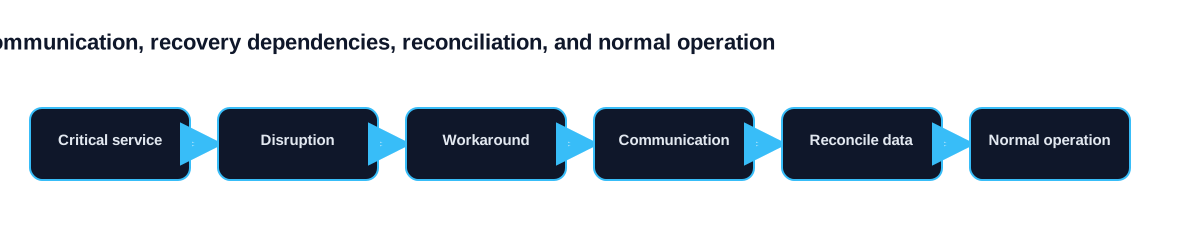
Plan the degraded service, not only the full recovery
A continuity plan should state what the business can deliver while systems are unavailable. For each important service, define the minimum acceptable output, authorized manual process, staffing requirement, information needed and point at which the workaround becomes unsafe or unsustainable. Include how records created during the outage will be protected and entered into restored systems without duplication.
Test one degraded process with the people who would perform it. A paper order form may appear workable until staff discover that pricing, inventory or customer authorization is unavailable. A remote-work plan may fail when identity or communications depend on the affected environment. Record these dependencies and decide which alternate tools can be prepared in advance. The result should help leadership choose whether to continue, reduce or suspend a service at each stage of the incident, while technical recovery proceeds on a separate but coordinated timeline.