Ransomware Protection for Canadian Small Business
A practical Canadian SMB guide to ransomware prevention, detection, response, and tested recovery across people, systems, and suppliers.
Ransomware protection for a small business combines prevention, early detection, controlled response, and tested recovery. No product can cover all four jobs. A business needs identity safeguards, secure email, current systems, network controls, monitored security signals, protected backups, and people who know what to do when an incident begins.
The goal is not to claim that an attack can never happen. It is to make unauthorized access harder, detect suspicious activity before it spreads, contain damage within an agreed scope, and restore the functions the business needs first.
The Canadian Centre for Cyber Security describes ransomware as a continuing threat to Canadian organizations. Its current outlook notes that ransomware affected organizations across sectors and that recovery costs associated with cyber incidents in Canada reached CAD 1.2 billion in 2023. The same source reports that only about 22% of surveyed businesses provided formal cyber security training to non-IT workers. These figures describe a broad national problem, not the risk or likely loss for a particular company. A company-specific assessment still needs to consider its systems, industry, data, suppliers, and ability to tolerate downtime. Source: Canadian Centre for Cyber Security, Ransomware Threat Outlook 2025 to 2027
What ransomware protection needs to accomplish
A practical ransomware program answers four questions:
- How will the business reduce the chance that an attacker gets usable access?
- How will suspicious activity be identified and investigated?
- Who can isolate systems, disable accounts, or block traffic during an incident?
- How will critical operations continue and recover if systems become unavailable?
These questions connect technical controls to business decisions. Multi-factor authentication matters because stolen credentials are a common route into email, remote access, and cloud services. Backups matter because the business may need to rebuild systems. Neither control is sufficient on its own. Authentication can be bypassed or misconfigured, and reachable backups can be deleted by an attacker who gains administrative access.
Reduce the ways attackers get in
Ransomware operations often begin with compromised credentials, phishing, exposed remote services, or exploitation of internet-facing systems. The 2025 Verizon Data Breach Investigations Report found that credential abuse, exploitation of vulnerabilities, and phishing were leading initial-access patterns across its breach dataset. It also reported that ransomware was present in a much larger share of small-business breaches than large-organization breaches in that dataset. Those findings should guide priorities, but they should not be read as the probability that a specific business will be attacked. Source: Verizon 2025 DBIR summary
Start with accounts that can change the environment: administrators, email administrators, backup operators, remote-support users, and vendors. Require phishing-resistant MFA where the platform supports it. Remove dormant accounts, separate normal and administrative identities, and review who can reset credentials or create access tokens.
Patch internet-facing systems according to risk. A fixed deadline for every update can create operational problems, particularly in manufacturing or specialized environments. A better process identifies exposed assets, checks whether a vulnerability is being actively exploited, tests the update where necessary, and records compensating controls when immediate patching is unsafe.
Email controls should include authentication, malicious attachment and URL inspection, impersonation protection, and a simple reporting process. DMARC, SPF, and DKIM help receiving systems assess whether a message was sent on behalf of a domain, but they do not validate whether every message is trustworthy. Employees still need a clear way to verify unusual requests through a separate channel.
Limit movement after initial access
An attacker who compromises one account or device should not automatically gain access to every server, file share, backup repository, and management console. Least privilege and network segmentation reduce the number of systems reachable from a single foothold.
Small businesses can begin with a few meaningful boundaries. Separate user devices from servers. Isolate guest and unmanaged devices. Restrict backup administration to dedicated accounts and management paths. Limit remote administration tools to approved users and devices. Record the business applications that require communication between zones, then allow only those flows.
Segmentation must reflect operations. Blocking traffic without understanding dependencies can interrupt production, health services, or customer transactions. Changes should be documented, tested, approved, and reversible.
Detect behaviour that prevention misses
Prevention reduces exposure but does not establish that an environment is safe. Detection tools watch for activity that may indicate misuse, such as unusual sign-ins, credential dumping, directory discovery, security-tool tampering, unexpected remote administration, or rapid access to many files.
Managed Detection and Response can provide monitoring, investigation, triage, escalation, and response coordination for agreed data sources. The exact service depends on the contract, connected telemetry, response playbooks, and authority granted by the customer. Endpoint isolation or account disabling should follow pre-approved rules. Production shutdowns, system restoration, and other high-impact actions normally require named business and technical owners.
When evaluating MDR, ask what is monitored, when analysts are available, how alerts are validated, which actions can occur without approval, who owns recovery, and what evidence the provider supplies after an incident. A response-time statement is meaningful only when its starting event, severity definition, coverage window, and exclusions are written into the service agreement.
Protect the ability to recover
Backups should be designed around recovery, not backup-job completion. Identify the systems and data required to operate, their dependencies, how much data loss the business can tolerate, and how quickly each service needs to return.
The 3-2-1-1-0 approach is a useful planning model: keep three copies of important data, use two storage types, retain one offsite copy, protect one copy through immutability or isolation, and verify zero backup errors through testing. The model is a starting point. Recovery may also require identity configuration, encryption keys, network settings, application installers, vendor access, and current documentation.
Run small restore tests on a regular schedule and conduct broader exercises for critical services. Record what was restored, how long it took, which dependencies failed, and what staff had to do manually. A successful file restore does not prove that the business can restore an application or resume a full process.
Prepare the response before an incident
A ransomware response plan should be short enough to use under pressure. Keep an offline copy with current contact details for leadership, IT, the security provider, legal counsel, the cyber insurer, key vendors, and communications owners.
The plan should define how staff report a suspected incident, how responders establish a trusted communication channel, who may isolate systems, how evidence is preserved, when counsel and the insurer are contacted, and who decides whether operations can resume. The Canadian Centre for Cyber Security maintains a ransomware playbook that can support this work. Source: Canadian Centre for Cyber Security ransomware playbook
Privacy obligations depend on the information involved, the organizations responsible for it, and the laws that apply. Under PIPEDA, an organization must report and notify a breach when it is reasonable to believe the breach creates a real risk of significant harm. Notification must occur as soon as feasible after the organization determines that the breach occurred. Provincial private-sector, health-information, contractual, and sector-specific rules may also apply. Legal counsel should determine the requirements for a specific incident. Source: PIPEDA section 10.1
A practical ransomware protection sequence
| Time horizon | Business action | Technical action | Evidence to retain |
|---|---|---|---|
| This week | Name incident decision-makers and verify emergency contacts | Enforce MFA on priority accounts and close unnecessary remote access | Account list, access review, contact sheet |
| First 30 days | Identify critical processes and acceptable downtime | Review exposed assets, endpoint coverage, email controls, and backup isolation | Asset inventory, gap register, restore-test result |
| First 90 days | Approve response authority and recovery priorities | Tune monitoring, segment critical systems, and test restoration | Signed playbooks, network diagrams, exercise notes |
| Ongoing | Review changes, suppliers, insurance requirements, and lessons learned | Patch by risk, monitor coverage, test backups, and rehearse response | Monthly exceptions, quarterly review, annual exercise record |
This table is an original planning aid. It should be adjusted to the business rather than treated as a compliance checklist.
How to choose the next investment
The next step depends on the current gap. A company without MFA on remote and administrative accounts should address identity exposure before buying another reporting tool. A business with good prevention but no after-hours investigation may need managed monitoring. A company with backups but no recent restore evidence should test recovery before assuming it can withstand an incident.
Cost comparisons should use the company’s own information. Estimate revenue or output affected by downtime, labour required for manual work, recovery vendor costs, contractual exposure, data-notification obligations, and the value of delayed orders. Compare those ranges with the cost and expected effect of proposed controls. Avoid presenting a universal return on investment because attack likelihood, control effectiveness, and business impact vary widely.
Questions to ask a ransomware protection provider
- Which systems, identities, and data sources are included?
- What activity is monitored, and during which hours?
- Who investigates an alert and decides it is an incident?
- Which containment actions are pre-approved?
- Who owns system rebuilding, backup restoration, and business recovery?
- How are third-party vendors and remote administration handled?
- What reports and evidence will the business receive?
- How are exclusions, unsupported systems, and changes recorded?
Clear answers make it easier to compare services and prevent gaps between the security provider, IT provider, insurer, and business leadership.
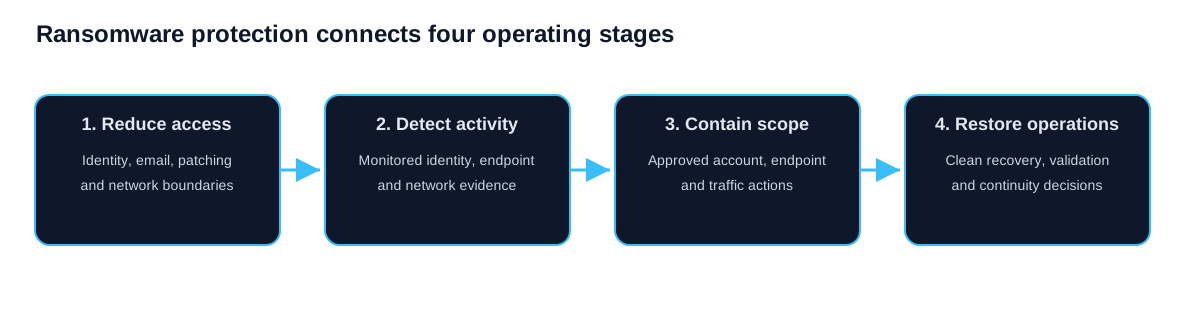
See how the four protection stages connect
The model below places each control under its main operating job. Some controls support more than one stage, but the diagram prevents a preventive product from being mistaken for complete detection, containment, or recovery coverage.
Explore the ransomware protection cluster
Use the supporting guides according to the decision in front of you.
| Reader need | Supporting guidance |
|---|---|
| Understand the threat | Ransomware explained for small businesses, common ransomware infection paths, Ransomware-as-a-Service, and ransomware trends for 2026 |
| Reduce exposure | Ransomware prevention practices, email security and ransomware, firewalls in ransomware defence, and employee ransomware awareness |
| Detect and prepare | MDR for ransomware protection, ransomware readiness assessment, ransomware FAQ, and tabletop exercise scenario |
| Respond and recover | Ransomware response planning, ransomware backup strategy, and ransomware business continuity |
| Address business and sector decisions | Ransomware costs, prevention investment analysis, manufacturing ransomware, and professional-services ransomware |
Sources
- Canadian Centre for Cyber Security: Ransomware Threat Outlook 2025 to 2027
- Canadian Centre for Cyber Security: Ransomware playbook
- NIST: Ransomware guidance for small business
- Verizon: 2025 Data Breach Investigations Report summary
- PIPEDA section 10.1
Review your current controls against the four stages. Discuss ransomware readiness with QuantM