Ransomware-as-a-Service: Why SMBs Should Care
Learn how ransomware-as-a-service affiliates obtain access and why SMB defences should focus on entry paths, expansion, detection, and recovery.
To discuss how Ransomware-as-a-Service: Why SMBs Should Care applies to your systems and responsibilities, contact QuantM Technologies for a scoped conversation.
Ransomware-as-a-Service (RaaS) is a criminal operating model in which developers or operators supply tooling and infrastructure to affiliates who obtain access and conduct attacks. Revenue-sharing and responsibilities differ among operations. For an SMB, the practical consequence is that access theft, intrusion, data theft, encryption, negotiation, and money movement may be handled by different participants using repeatable methods.
What RaaS changes for SMBs
- RaaS platforms operate like legitimate SaaS businesses, with customer support, updates, and profit sharing
- Major RaaS operations (LockBit, BlackCat, Clop) generate hundreds of millions in annual revenue
- Affiliates specifically target SMBs because they are easier to compromise than enterprises
- The RaaS model means SMBs now face attacks from thousands of independent operators, not just a few expert groups
How the RaaS operating model works
To understand why ransomware attacks have exploded in volume, you need to understand the business model behind them. Ransomware is no longer the domain of elite hackers writing their own code. It is a mature criminal industry with its own supply chain, customer support, marketing, and profit-sharing agreements.
Ransomware-as-a-Service has industrialized cyber crime. The developers build the weapons. The affiliates pull the trigger. And SMBs are overwhelmingly the targets, because they offer the optimal combination of valuable data, weak defenses, and willingness to pay.
Defensive implications for SMBs
How RaaS works. RaaS developers create and maintain the ransomware software, including the encryption engine, the payment portal, the negotiation interface, and the data leak site. They recruit "affiliates" through dark web forums with marketing that mirrors legitimate SaaS platforms, advertising ease of use, customer support, high conversion rates, and generous revenue sharing.
Why this matters for SMBs. Before RaaS, ransomware attacks required significant technical skill. Only a few hundred capable threat actors existed globally, and they primarily targeted large, high-value organizations. RaaS has multiplied the number of active attackers by orders of magnitude. Thousands of affiliates, many with only basic technical skills, now have access to sophisticated ransomware tools.
The RaaS supply chain. RaaS is one part of a broader criminal supply chain. Initial access brokers specialize in compromising organizations and selling that access to ransomware affiliates. Hosting providers may supply infrastructure designed to resist disruption, while cryptocurrency mixing services can obscure payment flows. Online criminal marketplaces connect buyers and sellers. This division of labour means disrupting one operator may leave other access and infrastructure providers available.
Notable RaaS operations. LockBit has been the dominant RaaS platform, responsible for more attacks than any other group. BlackCat (ALPHV) introduced triple extortion tactics. Clop specialized in mass exploitation of zero-day vulnerabilities. Play targets mid-market businesses with high revenue. Despite law enforcement takedowns, these groups rebrand and reconstitute rapidly.
What SMBs can do. RaaS lowers the skill and infrastructure needed to conduct an attack, so smaller organizations should plan for the common access and recovery failures affiliates exploit. Email security, monitored detection, MFA, patching, tested backups, and employee reporting address different stages of an attack. An MSSP can help when the business does not have enough internal coverage to monitor alerts, investigate activity, and coordinate containment.
Frequently Asked Questions
How much do ransomware-as-a-service kits cost?
Criminal pricing and revenue-sharing arrangements change and are not a useful control input for an SMB. Focus on the access paths affiliates can use in your environment, the telemetry that would reveal expansion, and the authority to contain affected identities or endpoints.
Can law enforcement stop RaaS operations?
Law-enforcement actions can disrupt infrastructure, seize systems, publish decryption resources, or create uncertainty among affiliates. Those actions do not remove the need for local controls because access brokers and affiliates can change tools or partners. SMB planning should therefore focus on the access paths, privileges, monitoring gaps, and recovery dependencies within its own environment.
Are RaaS attacks less sophisticated than traditional ransomware?
RaaS can give affiliates access to tooling, infrastructure, and operating support, but affiliate capability and campaigns vary. SMBs should not assume that a less experienced operator creates a harmless event. Prioritize the entry paths, privileges, monitoring, response authority, and recovery dependencies present in the environment.
Defend against the access economy behind RaaS
Translate the RaaS model into the access paths an SMB can control. Review credential theft, exposed services, remote-management tools, supplier access, data exfiltration, and recovery interference. The names of criminal groups will change faster than the underlying access and privilege problems, so track those problems with current evidence.
Define scope, owners, and proof
Include identity, endpoint, network, cloud, vendor-management, and incident-response owners. Assign one accountable owner and an alternate to each decision. Set the boundary around external access, privileged pathways, unmanaged tools, and unusual data movement. Record exclusions so leadership can see what the assessment does not prove.
Measure what the exercise establishes
One useful measure for this subject is time to revoke stolen credentials across cloud, VPN, endpoints, and active sessions. Pair it with control coverage, age of open exceptions, time to reach decision-makers, restore success, and the percentage of remediation items closed by their due dates. Measures need definitions. For example, “response time” may mean alert acknowledgement, analyst investigation, customer escalation, containment, or full recovery. Those are different clocks.
Source and visual plan
- Microsoft Digital Defense Report 2025
- Canadian Centre for Cyber Security, Ransomware playbook
- Canadian Centre for Cyber Security, Ransomware threat outlook 2025 to 2027
- PIPEDA section 10.1
Translate the RaaS model into defensive priorities
Ransomware-as-a-service separates tool development, access acquisition, intrusion activity and extortion. That division allows different operators to reuse stolen credentials, exposed services and commodity tools. Defenders should focus on the access and behaviour they can observe rather than trying to predict which brand name will appear in a ransom note.
The security and identity owners can begin with one externally reachable identity or service that could be resold as access. The review should include credential theft, remote tools, privileged pathways, data movement and backup access. Keeping that boundary visible helps participants distinguish a demonstrated result from an assumption about the wider environment.
| Review area | Evidence | Failure to correct |
|---|---|---|
| Initial access | Exposure inventory and authentication evidence | Unknown remote services sit outside ownership |
| Tool abuse | Approved remote-management inventory and monitoring | Legitimate tools are trusted by default |
| Data movement | Normal destinations, volume alerts and investigation procedure | Exfiltration is considered only after encryption |
| Extortion readiness | Counsel, insurer, evidence and communication roles | The ransom note becomes the first decision point |
Run a safe validation: revoke the identity across cloud and remote access, terminate sessions and confirm that new attempts generate an investigation. Record the expected result, observed result, limitation, owner and retest date. The record is more useful than a generic score because another reviewer can reproduce the check.
Related reading: the common access routes, behavioural investigation, recovery options that reduce pressure. Each link answers an adjacent question and keeps this article focused on its own intent.
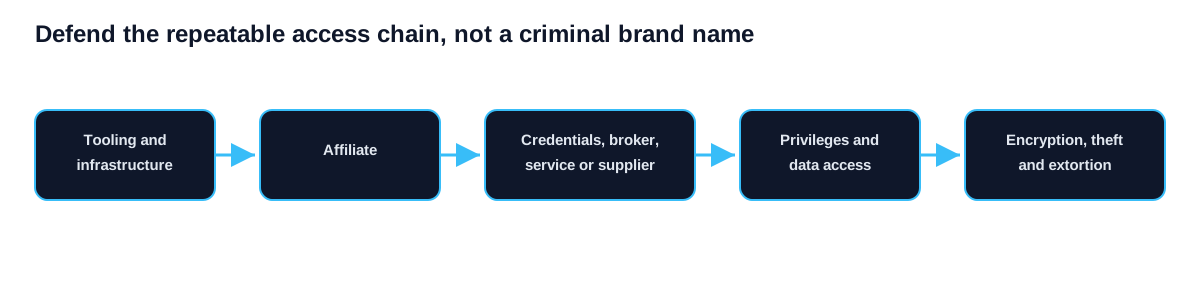
Put defence against the RaaS access chain into operation
Choose one likely access path and trace how an affiliate could move from entry to privileges, data, and recovery systems. Then work through these steps:
- Inventory resellable access paths. Name the owner, scope and expected result before changing a control.
- Monitor remote tools and privileged movement. Record exceptions and dependencies instead of treating partial coverage as complete.
- Prepare for data theft and extortion claims. Preserve the evidence and assign follow-up work with a retest date.
Evidence to retain
- External identity and service list should show the current scope rather than a planned future state.
- Approved remote tool inventory should identify the person or system that produced the record.
- Unusual transfer investigation should include the date, limitation and unresolved exception.
- Extortion decision contacts should connect the technical result to the affected business service.
Evidence for RaaS-defence ages. Review it after a major platform, supplier, identity, policy or staffing change. If the environment no longer matches the tested scope, mark the prior result as historical and schedule a new check.
Review questions
- Can stolen sessions be revoked?
- Are remote tools allow-listed?
- Who reviews large transfers?
- Can backups survive privileged access?
- Who assesses an extortion claim?
Assign access, privilege, monitoring, and recovery gaps according to the system involved, not the criminal group named in a report. Retest the broken path after the change. The small-business ransomware guide provides the complete control sequence.
Focus on the access path, not the group name
Ransomware brands, affiliates and infrastructure change quickly. A small business gets more durable value from tracking how access was obtained and expanded than from trying to recognize every criminal name. Review exposed remote services, stolen credentials, unpatched internet-facing systems, malicious email, third-party access and unmanaged devices. Each path should have a preventive control, a detection source and an owner who can authorize containment.
Threat reporting can help teams update priorities, but it should not replace evidence from their own environment. If a report describes exploitation of a product the company does not use, that finding is not the immediate priority. If sign-in logs show repeated access attempts against an administrator, the identity control deserves attention even when no named campaign is associated with it. This approach connects external intelligence to an asset, exposure and action. It also remains useful when an affiliate changes tools or a ransomware operation reappears under a different label.