How MDR Helps Stop Ransomware in Real Time
See how MDR monitoring, investigation, escalation, and pre-authorized containment can limit ransomware activity before recovery begins.
To discuss MDR coverage, response authority, and ransomware readiness for your environment, contact QuantM Technologies for a scoped conversation.
Managed Detection and Response can help stop ransomware by monitoring agreed telemetry, investigating suspicious behaviour, escalating confirmed activity, and carrying out response actions that the customer has authorized. Its effectiveness depends on coverage, configuration, signal quality, available responders, and clear authority. MDR does not replace identity controls, patching, email security, backups, continuity, or recovery testing.
What MDR can and cannot do
- Service hours, telemetry sources, escalation routes, and response authority must be confirmed in the contract and operating procedure.
- Endpoint isolation or account action may be automated, analyst-led, customer-approved, or unavailable, depending on scope.
- Detection can occur at several attack stages, but no provider sees every identity, endpoint, network, cloud, or supplier event by default.
- The customer still owns business decisions, restoration priorities, legal advice, and unresolved coverage gaps.
What Is MDR (Managed Detection & Response)?
Managed Detection and Response is a cybersecurity service where a team of expert security analysts monitors your IT environment 24/7 using advanced detection technology, investigates suspicious activity, and responds to confirmed threats on your behalf. Unlike buying security software and managing it yourself, MDR is a fully managed service, you get the technology and the people to operate it.
Why Traditional Antivirus Can't Stop Ransomware
Traditional antivirus relies on signature databases, libraries of known malware code patterns. When a file enters your system, antivirus checks it against the database. If it matches a known threat, it is blocked. If it does not match, it is allowed through.
Signature-based antivirus can miss activity that does not match a known malicious file. Attackers may also misuse PowerShell, WMI, remote administration, valid credentials, or other tools that have legitimate purposes. Detecting that behaviour requires context from identities, endpoints, networks, and administrative actions. Antivirus remains one preventive layer, but its presence does not demonstrate that investigation and containment will occur.
Real-Time Threat Detection with MDR
MDR adds monitored behavioural signals to file and reputation checks. Depending on the agreed telemetry and scope, analysts can investigate suspicious process, identity, endpoint, or network activity even when a specific ransomware file has not been catalogued.
At initial access, MDR detects anomalous email attachment execution (Word spawning PowerShell), suspicious login attempts from unusual locations, and exploitation of vulnerable services.
During reconnaissance, MDR identifies network scanning, directory enumeration, and unauthorized access to sensitive file shares that indicate an attacker mapping your environment.
At lateral movement, MDR catches unauthorized RDP connections between workstations, credential dumping attempts (Mimikatz, LSASS dumps), and anomalous SMB traffic patterns.
Before encryption, MDR detects the critical pre-encryption indicators: Volume Shadow Copy deletion, security tool tampering, and mass file access patterns that precede encryption.
Automated Containment & Isolation
Containment should follow the authority agreed before an incident. Available actions may include endpoint isolation, account restriction, process termination, blocking a connection, or escalating to the customer's incident lead. Some actions can disrupt a critical service or erase volatile evidence, so the operating procedure should identify what can happen automatically, what requires analyst confirmation, and what requires customer approval.
Test that procedure with a benign alert. Record when the signal appeared, when it was acknowledged, what evidence supported the decision, who authorized the action, and whether the affected system remained manageable. That measured sequence is a stronger service expectation than an unsupported universal response-time claim.
Incident Response Capabilities
MDR does not stop at containment. After isolating the threat, the MDR team conducts a full incident investigation: tracing the attack chain from initial access through every system the attacker touched, identifying all compromised accounts and endpoints, determining whether data was exfiltrated, and providing detailed remediation guidance for full recovery.
Frequently Asked Questions
How is MDR different from EDR?
EDR is endpoint technology that records and analyzes activity and can support response actions. MDR is a managed service that investigates agreed telemetry and follows defined escalation or response procedures. Coverage hours, connected data, response authority, retention, and customer responsibilities vary by service. An organization comparing MDR providers should verify each of those terms rather than assuming that every service provides the same operating model.
Can MDR prevent all ransomware attacks?
No. MDR can improve the chance that suspicious activity is investigated and contained, but coverage and response are not universal. Prevention also depends on identity, exposure management, patching, email controls, suppliers, user reporting, network design, backups, and the ability to restore cleanly.
How quickly does MDR respond to ransomware?
The answer depends on the service definition and the event. Ask the provider to separate alert acknowledgement, investigation, customer escalation, containment, and recovery because they are different clocks. Review contractual commitments, prerequisites, exceptions, and measured exercise evidence for your environment.
What MDR can and cannot do during ransomware activity
Evaluate MDR as an operating agreement between the customer and provider. List the telemetry the provider actually receives, how it validates an event, who receives an escalation, and which endpoint or identity actions are authorized in advance. This reveals the coverage and authority gaps that a service label or dashboard cannot show.
Establish ownership and evidence
The customer and provider should maintain one shared responsibility record. It should name telemetry owners, escalation contacts, approved response actions, excluded assets, evidence retention, and the boundary between containment and recovery. Test contacts and authority with the people who would actually receive the escalation.
Set the assessment boundary before testing. At minimum, include approved automated and analyst-led actions. Dependencies deserve the same attention as the main application. A service may be technically restored yet remain unusable because identity, DNS, network access, encryption keys, or a third-party connection is unavailable.
Measure the result without inventing precision
Report separate clocks for signal receipt, analyst acknowledgement, investigation, customer escalation, approved containment, and closure. State the test severity and coverage window. Combining those events into a single “response time” hides where a delay occurred and what the contract actually promises.
Preserve the investigation record long enough for the customer to review the evidence, action, limitation, and follow-up decision after the event closes.
Source and next step
- Microsoft ransomware response guidance
- Canadian Centre for Cyber Security, Ransomware threat outlook 2025 to 2027
- PIPEDA section 10.1
- NIST ransomware guidance for small businesses
Define the MDR operating agreement
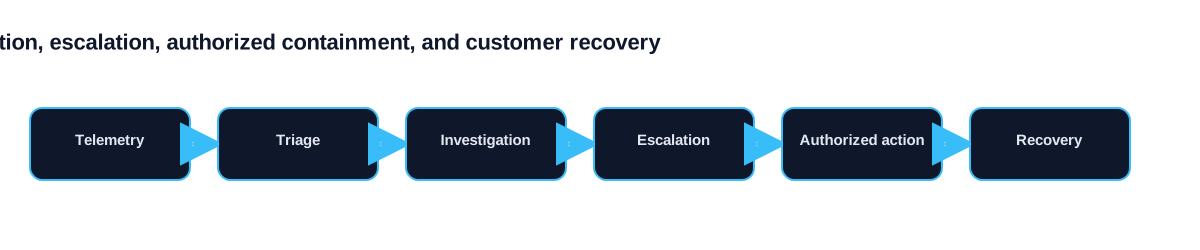
MDR helps only when the provider receives the right telemetry, has current contacts, and knows which actions are authorized. The service description should separate alert collection, triage, investigation, escalation, containment and recovery coordination. Buyers can then test the operating agreement without relying on a promise that every incident will be stopped.
Use a benign endpoint or identity alert that resembles an early attack signal as the working example. Ask the security service owner to map endpoint coverage, identity logs, after-hours contacts and response authority, then follow the example through normal operation, disruption and recovery. The review should reveal where access, evidence or authority changes hands.
| Point in the scenario | Required evidence | Decision risk |
|---|---|---|
| Telemetry | Covered endpoints, identities, servers and cloud services | Licences exist but important assets do not report |
| Investigation | Case record, evidence, severity reason and disposition | The customer receives only an automated alert |
| Escalation | Primary and alternate contacts with tested channels | The process stops when one person is unavailable |
| Response | Written authority for isolation, session revocation and blocking | Provider and customer assume the other will act |
Finish by asking the team to follow the alert from generation to investigation record, customer escalation and an approved response decision. Preserve the result and assign each gap to the person who can change the system or procedure. The next exercise should confirm that the gap was corrected rather than introducing a new scoring scheme.
Readers can continue with the broader MDR operating model, continuous monitoring responsibilities, the ransomware response plan. Each destination answers a different operational question and supports the hub-and-spoke structure.
Put an MDR ransomware operating agreement into operation
Validate one signal and escalation path from end to end before assuming broad MDR coverage. The first operating test should follow these steps:
- Confirm covered telemetry and exclusions. Name the owner, scope and expected result before changing a control.
- Approve escalation and response authority. Record exceptions and dependencies instead of treating partial coverage as complete.
- Test a benign alert after onboarding. Preserve the evidence and assign follow-up work with a retest date.
Evidence to retain
- Asset coverage export should show the current scope rather than a planned future state.
- Complete investigation record should identify the person or system that produced the record.
- Primary and alternate contact result should include the date, limitation and unresolved exception.
- Authorized response action log should connect the technical result to the affected business service.
Evidence for MDR operating ages. Review it after a major platform, supplier, identity, policy or staffing change. If the environment no longer matches the tested scope, mark the prior result as historical and schedule a new check.
Review questions
- Who watches after hours?
- What starts the service clock?
- Which actions need approval?
- What evidence follows an incident?
- How are unsupported systems recorded?
Assign telemetry, contact, and authority gaps to the customer or provider named in the service agreement. Close each item with a repeat of the original signal or contact test. Use the small-business ransomware guide to see where MDR fits beside preventive controls and recovery work.
Learn more about QuantM's managed detection and response service for Canadian businesses.