AI Alignment for Business: Verifiable Controls
Make business AI behaviour reviewable with defined authority, enforceable rules, testing, monitoring, and accountable owners.
AI alignment is the effort to make an AI system behave consistently with intended goals, values, constraints, and user expectations. For a business, that means more than asking whether a model is generally helpful. It means defining the approved job, limiting the system's authority, testing predictable failure cases, and monitoring what happens in real use.
Alignment is not a one-time model setting. It is an operating discipline across governance, design, deployment, and review.
What does AI alignment mean in a business setting?
An aligned business system should:
- perform the task it was approved to perform
- follow relevant policy and legal requirements
- respect access and data boundaries
- avoid taking actions outside its authority
- communicate uncertainty where appropriate
- fail in a controlled way
- remain reviewable by an accountable person
These expectations must be made specific. “Act responsibly” is difficult to test. “Do not send a client message without approval” can be implemented, logged, and verified.
Why alignment can fail
The objective is vague
An instruction such as “maximize customer satisfaction” can conflict with privacy, refund, legal, or recordkeeping obligations. The system needs ranked constraints and clear escalation rules.
The context is incomplete
A model may not know the current policy, user role, contract terms, or client classification. It can produce a plausible answer that does not fit the actual case.
Permissions exceed the task
Even a well-instructed agent becomes riskier when it can read every file or execute high-impact actions. Behavioural rules should be supported by technical restrictions.
Tests do not match real use
A system may perform well on ordinary examples and fail under ambiguous requests, malicious content, tool errors, or unusual data. Alignment needs negative and adversarial testing.
Business rules change
Policies, products, laws, and risk tolerances change. An AI system can drift out of alignment if its instructions, knowledge sources, tests, and approvals are not updated.
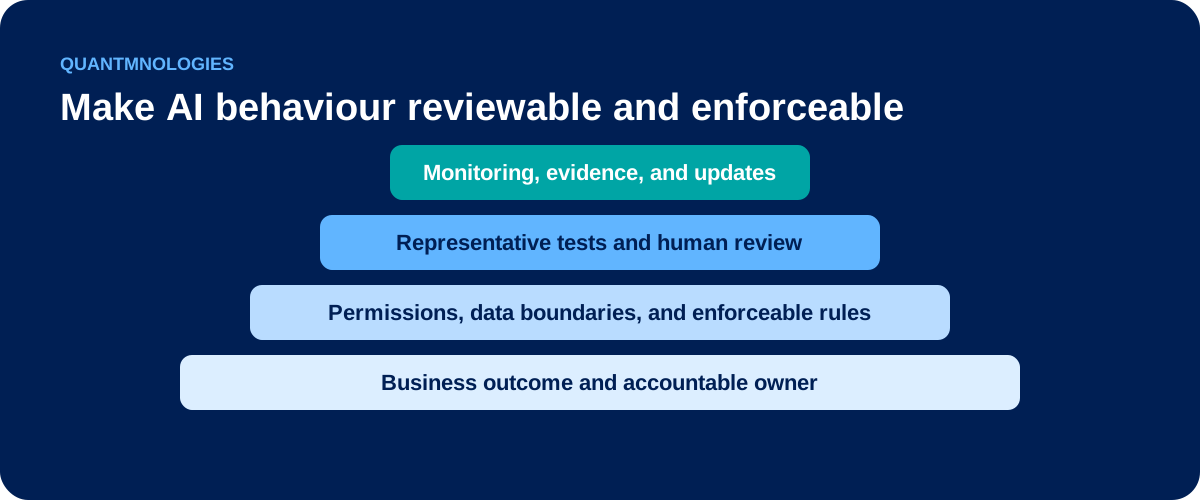
A practical alignment control stack
| Control area | Accountable owner | Evidence to retain |
|---|---|---|
| Approved outcome | Business owner | Defined purpose and prohibited outcomes |
| Access and authority | IT or security owner | Scoped identities and permission review |
| Tests and review | Workflow owner | Test cases, results, and approved exceptions |
| Monitoring and updates | Business and security owners | Findings, changes, and retest record |
1. Define the approved outcome
Write down the use case, users, input data, allowed outputs, prohibited actions, required approvals, and success criteria. Assign a business owner.
2. Translate policy into enforceable rules
Use system instructions for behavioural guidance, but also apply access controls, data filters, tool permissions, transaction limits, and workflow gates.
3. Limit data and authority
Give the system only the records and actions required for its task. Separate client contexts and environments. Require a person to approve high-impact or irreversible actions.
4. Build representative evaluations
Test normal, ambiguous, out-of-scope, malicious, and failure scenarios. Include examples involving sensitive data, conflicting instructions, unavailable tools, and requests beyond authority.
5. Monitor outcomes
Track refusals, overrides, policy failures, incorrect retrieval, unauthorized tool attempts, escalations, and user corrections. Logs should support investigation without collecting unnecessary sensitive content.
6. Review and update
Use incident findings and reviewer feedback to update policies, prompts, controls, and evaluation cases. NIST's AI RMF frames this as continuous governance, mapping, measurement, and management.
How to measure alignment
Useful measures depend on the use case, but may include:
- policy-compliant response rate
- unauthorized action attempts blocked
- correct escalation rate
- sensitive-data exposure findings
- grounded-answer rate
- human override and correction rate
- performance across adversarial tests
- time to detect and correct a control failure
A single accuracy score is not enough when the system can access sensitive data or take action.
Executive review checklist
- Is the approved purpose narrow enough to test?
- Which policies and values take priority when they conflict?
- What data and tools can the system access?
- Which actions require human approval?
- How is uncertainty communicated?
- What evidence shows the system follows these rules?
- Who reviews failures and authorizes changes?
- When was the last adversarial evaluation?
FAQ
Is AI alignment the same as AI safety?
They overlap, but they are not identical. Alignment concerns whether behaviour matches intended objectives and constraints. Safety considers the broader prevention and management of harmful outcomes.
Can a system prompt align an AI model?
A system prompt can guide behaviour, but it is only one layer. Reliable deployment also needs permissions, data controls, testing, monitoring, and human accountability.
Who owns AI alignment in a company?
The business owner should be accountable for the use case, supported by technology, security, privacy, legal, and operational stakeholders as appropriate.
Make alignment testable
Begin with one use case. Define what the system may see, say, and do, then build tests for the boundaries that matter most. That turns an abstract alignment goal into evidence the business can review.
QuantM helps Canadian SMBs move from AI interest to approved use cases, working tools and workflows, team training, and secure operating practices. Start with a free AI readiness assessment to identify the strongest next move.