AI Robustness Testing: Will It Behave Safely?
Learn how to test AI robustness across normal use, edge cases, malicious inputs, system changes, tool actions, and production monitoring.
AI robustness testing checks whether an AI system continues to behave within acceptable limits when inputs, users, data, models, integrations, or operating conditions change.
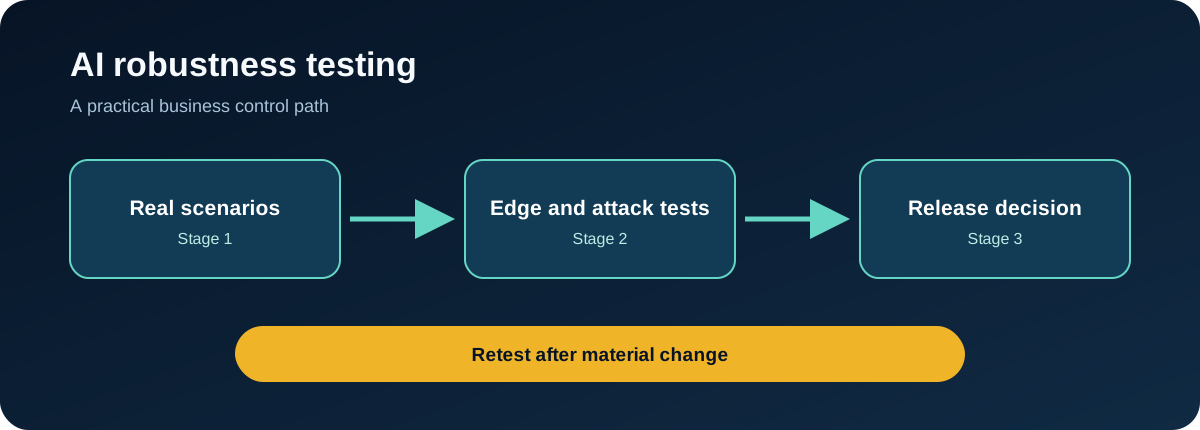
Adversarial testing is part of robustness, but it is not the whole practice. A system can fail because of an ordinary typo, an outdated source, a missing field, a provider update, a long conversation, or an unavailable tool.
Test the business workflow
A model benchmark does not show whether the deployed workflow is safe. The real system may include:
- identity and access control
- prompts and conversation history
- uploaded files
- retrieval from business repositories
- a third-party model
- output checks
- tool calls
- human approval
- downstream systems
Robustness testing should cover these components together.
NIST's AI test, evaluation, validation, and verification work includes accuracy, explainability, privacy, reliability, robustness, safety, security, and harmful-bias mitigation. NIST
Build tests from real failure scenarios
Start with the business outcome that must be protected. Then test several categories.
Normal use
Confirm that common tasks produce useful output, respect access rules, and follow the expected review process.
Edge cases
Use incomplete requests, conflicting instructions, unusual file formats, long conversations, missing sources, ambiguous names, and unavailable integrations.
Sensitive data
Check how the system handles personal information, client records, credentials, and cross-client requests. Confirm that redaction, blocking, and escalation work as designed.
Adversarial use
Test prompt injection, jailbreaking, poisoned documents, encoded instructions, repeated bypass attempts, excessive requests, and attempts to misuse tools.
Change and failure
Test model updates, prompt changes, permission changes, stale indexes, provider outages, timeouts, and partial tool failures. The system should fail in a controlled way.
Human oversight
Confirm that reviewers receive enough context, approval cannot be bypassed, and urgent or high-volume conditions do not turn review into a formality.
Define acceptance criteria
"The AI worked" is not a test result. Define measurable expectations for:
- task success
- unsupported claims
- sensitive-data exposure
- unauthorized retrieval
- prohibited tool actions
- correct refusal and escalation
- reviewer accuracy
- response time and cost
- logging and alert creation
NIST's AI RMF Measure guidance recommends documented robustness measures, realistic test sets, and approaches such as unit, integration, functional, chaos, adversarial, and stress testing. NIST AIRC
Use three levels of evaluation
NIST's ARIA program describes model testing, red teaming, and field testing as distinct evaluation levels. NIST ARIA
For a business, that translates into:
- test the model or component against defined cases
- have testers actively search for failure and abuse paths
- observe the system in its real operating context with controlled monitoring
Each level reveals different problems.
Make testing continuous
Create a regression set from past failures, incidents, user complaints, and newly identified attack patterns. Rerun it after material changes to the model, prompt, knowledge source, tool, permission, or policy.
Production monitoring should look for drift, unusual usage, repeated control failures, and outcomes that no longer meet the acceptance criteria.
Leadership questions
- Which business outcomes must remain safe and reliable?
- Are test cases based on realistic users and data?
- Do we test the complete workflow and not only the model?
- What result blocks release?
- Who accepts remaining risk?
- Which changes trigger retesting?
- Do production failures become future test cases?
Robustness is not a one-time score. It is evidence that the AI-assisted workflow can handle expected variation, foreseeable mistakes, deliberate abuse, and operational change without exceeding the business's risk tolerance.
FAQ
Why does AI robustness testing matter to a business?
An AI workflow can appear reliable on familiar examples and fail when language, data quality, user behaviour, integrations, or operating conditions change. Robustness testing shows whether those failures remain within an acceptable business boundary.
Who should own this control?
The business owner should define failure consequences and release criteria. Technical and security teams should build the test harness, and qualified reviewers should judge domain-specific outcomes that a generic score cannot settle.
What is the first practical step?
Choose one live workflow and collect normal, ambiguous, incomplete, adversarial, and changed-condition scenarios. Define the expected safe response before running the test, then assign an owner to every failure that blocks release.
Put this control into practice
Start with one AI workflow that handles sensitive, operational, or client information. Document its testing, issue tracking, and control updates. Test the process with a normal request, an unsafe request, and an error case before expanding its use.
QuantM helps Canadian SMBs connect AI governance with identity, Microsoft 365, cybersecurity, and documented business controls. If your team needs a practical baseline, an AI and Cyber Governance Diagnostic can identify the first control gaps to address.
Related AI security guides
- AI Red Teaming for Business Workflows
- Concept Drift Monitoring: Keeping AI Reliable After Launch
- AI Model Integrity Verification: Proving the Right Model Is Running
- Prompt Jailbreaking: What It Means for Business AI Security