Concept Drift Monitoring: Keep AI Reliable
Learn how to monitor concept drift, distinguish it from data drift, set thresholds, validate alerts, and respond when model performance changes.
Concept drift occurs when the relationship a model learned between inputs and the intended outcome changes over time. A model that was accurate at launch may become less reliable even though its code and weights have not changed.
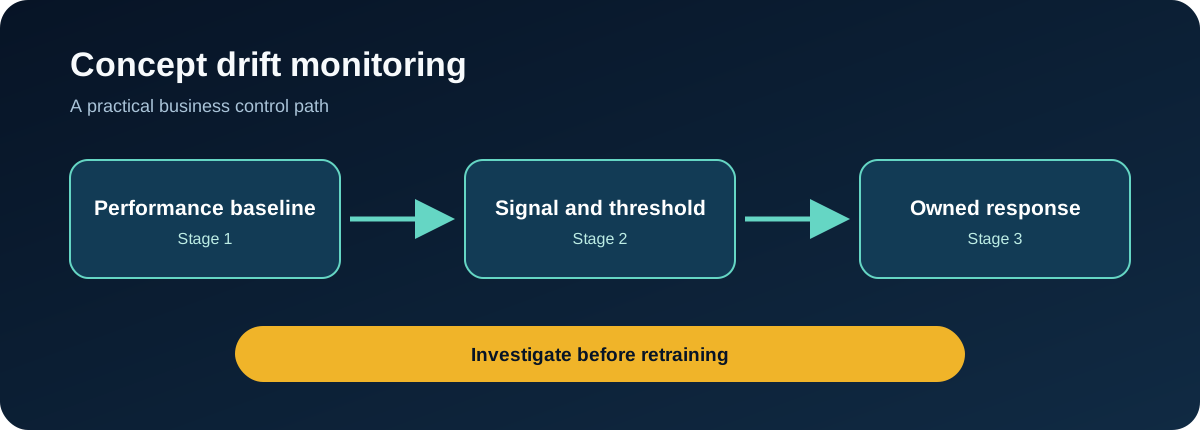
Monitoring should detect meaningful change early and connect each alert to a named owner, investigation step, and business response.
Concept drift versus data drift
Data drift means the distribution of model inputs has changed. Customer mix, document types, sensor values, or transaction patterns may differ from the training baseline.
Concept drift means the relationship between inputs and outcomes has changed. The same signals may no longer predict the target in the same way.
Performance drift is an observed decline in metrics such as error rate, precision, recall, or calibration.
Data drift can be measured without labels. Confirming concept or performance drift often requires reliable ground-truth outcomes, which may arrive later.
Why drift matters
Undetected drift can create incorrect decisions, inconsistent service, missed threats, unfair outcomes, and loss of confidence in the system. It can also signal a process change, data-quality failure, feedback loop, or adversarial activity.
Drift is not automatically a cyberattack. It is a condition that requires investigation.
Build a monitoring plan
Establish a baseline
Record training and validation distributions, production performance, known limitations, user groups, operating conditions, and approved thresholds.
Monitor several signal types
- input feature and document distribution
- missing values and schema changes
- model confidence and calibration
- prediction and refusal rates
- verified outcome metrics
- performance across relevant groups
- user corrections and overrides
- latency, errors, and service availability
Set risk-based thresholds
Not every statistical change matters to the business. Link thresholds to decision impact, model criticality, and the cost of false alerts.
Preserve context
Record model version, data version, prompt or policy version, deployment change, and business event. This helps distinguish drift from a release defect or data-pipeline problem.
Assign response owners
Define who validates the alert, who can restrict or stop the model, and who approves retraining or redeployment.
Responding to a drift alert
- Confirm data quality and monitoring health.
- Compare recent data and outcomes with the approved baseline.
- Identify affected users, decisions, and time period.
- Check recent model, prompt, policy, and pipeline changes.
- Apply a fallback, human review, or service limit if impact is material.
- Decide whether to recalibrate, retrain, redesign, or accept the change.
- Test the updated system before release.
- Record the decision and update thresholds where justified.
Automatic retraining is not always the right response. Poor or manipulated new data can make the model worse.
Executive review checklist
- Which models have production baselines?
- Which outcomes provide ground truth?
- Are thresholds tied to business impact?
- Is performance reviewed across important groups?
- Who receives and validates alerts?
- Can a high-risk model fall back to human review?
- Are model and data changes traceable?
- Is retraining treated as a controlled release?
FAQ
Is concept drift the same as data drift?
No. Data drift concerns changes in inputs. Concept drift concerns changes in the relationship between inputs and outcomes.
Does drift mean the model was attacked?
Not necessarily. Drift can arise from legitimate business, population, policy, or environmental change. Security investigation may still be appropriate when the pattern is unusual.
Should a model retrain automatically after every alert?
No. Validate the cause and quality of new data first. High-impact systems need controlled evaluation and approval before an updated model is released.
Make every alert actionable
For each critical model, define the baseline, monitored signals, alert threshold, owner, fallback, and approval path. Monitoring becomes useful when it changes a decision.
Put this control into practice
Start with one AI workflow that handles sensitive, operational, or client information. Document its logging, alert ownership, and response procedures. Test the process with a normal request, an unsafe request, and an error case before expanding its use.
QuantM helps Canadian SMBs connect AI governance with identity, Microsoft 365, cybersecurity, and documented business controls. If your team needs a practical baseline, an AI and Cyber Governance Diagnostic can identify the first control gaps to address.
Related AI security guides
- AI Model Explainability: What a Business Should Be Able to Explain
- AI Robustness Testing: Will the System Behave Safely When Conditions Change?
- AI Model Integrity Verification: Proving the Right Model Is Running
- AI Output Validation: What to Check Before AI-Generated Work Leaves the Business