Ransomware Trends to Watch in 2026
Review ransomware developments relevant to Canadian SMBs in 2026 and translate dated threat evidence into practical control and recovery decisions.
To discuss how Ransomware Trends to Watch in 2026 applies to your systems and responsibilities, contact QuantM Technologies for a scoped conversation.
Current public reporting points to several ransomware developments worth testing against an SMB's environment: more convincing social engineering, pressure beyond encryption, identity and edge-device access, abuse of suppliers and remote-management paths, and criminal specialization. These are dated observations, not predictions that every business will face the same campaign.
Trend decisions for 2026
- Data theft and external pressure mean a successful restore may not end the incident.
- Supplier and administrative access should be inventoried, restricted, monitored, and revocable.
- Trend reports should change a control decision only when the described exposure exists in the business.
How to read ransomware trend reports
Threat reports describe different regions, sectors, incident populations, and time periods. Record the publication date, dataset, scope, and limitation before turning a headline into a priority. Then map the observation to real assets, access paths, controls, owners, and recovery dependencies.
A useful trend decision can be written plainly: act now, monitor with a review date, or mark not applicable with evidence. This keeps time-sensitive reporting separate from durable requirements such as strong identity, controlled administration, monitored systems, protected recovery copies, and practiced response.
Trends that require a control decision
More convincing social engineering. Generative tools can help criminals produce polished messages, images, audio, or scripts, while compromised accounts can make requests appear to come from a known relationship. Employees should not depend on spelling mistakes as the primary warning. High-impact requests need an independent verification path, and technical teams need identity, email, endpoint, and reporting evidence that can be investigated together.
Pressure beyond encryption. An attacker may claim to have copied information, contact customers or partners, or disrupt public services in addition to encrypting systems. The response plan should preserve evidence, assess information impact, protect communication channels, and involve counsel and insurers where applicable. Backups remain essential, but they address restoration rather than every extortion claim.
Supplier and administrative paths. A compromised software provider, service provider, cloud tenant, update mechanism, or remote-management identity can create downstream access. Inventory these paths, use separate least-privilege identities, log administrative activity, define who can revoke access, and make sure recovery does not depend on the same compromised supplier.
Evasion and legitimate-tool abuse. Attackers can use built-in administration tools, remote-management software, stolen sessions, security-control changes, and selective encryption to reduce obvious malware signals. Detection should combine endpoint, identity, network, cloud, and administrative context where those sources are in scope.
Changing legal and insurance conditions. Reporting duties, privacy rules, sanctions, policy terms, and insurer requirements can change. Maintain current Canadian legal and insurance contacts and review dated primary sources. A product checklist does not determine compliance, coverage, or whether notice is required for a particular event.
Frequently Asked Questions
Will AI make ransomware attacks unstoppable?
No. More convincing content can make social engineering harder to judge, but the defensive response does not depend on buying a tool labelled AI. Independent verification, strong authentication, restricted privilege, monitored identities and endpoints, accessible reporting, and authorized containment remain useful regardless of how a message was created.
How are ransomware groups adapting to law enforcement takedowns?
Law-enforcement action can disrupt infrastructure, identify operators, recover keys, and change criminal behaviour, but organizations still need their own controls and recovery plan. Group names and infrastructure can change. Track the access path and observed behaviour so defensive work remains useful when attribution is uncertain.
What is the most important defense trend for SMBs in 2026?
No single trend control is most important for every SMB. Begin with critical services and current evidence, then review remote and privileged identities, internet exposure, supplier access, monitored assets, protected recovery copies, response authority, and tested restoration. MDR may support detection and response when its scope fits those needs.
Turn 2026 ransomware trends into operating decisions
A trends review needs dated sources and a reason each observation changes a business decision. Track data theft, identity-led access, edge-device exploitation, remote-management abuse, supplier compromise, pressure tactics, and recovery interference. Record the source date, confidence, affected control, decision owner, and next review date instead of treating a market statistic as a forecast for one company.
Define scope, owners, and proof
Include security, IT operations, business continuity, privacy, procurement, and leadership. Assign one accountable owner and an alternate to each decision. Set the boundary around trend evidence, exposure relevance, existing controls, and a dated decision to act or monitor. Record exclusions so leadership can see what the assessment does not prove.
Measure what the exercise establishes
One useful measure for this subject is number of material threat changes translated into an owned control test. Pair it with control coverage, age of open exceptions, time to reach decision-makers, restore success, and the percentage of remediation items closed by their due dates. Measures need definitions. For example, “response time” may mean alert acknowledgement, analyst investigation, customer escalation, containment, or full recovery. Those are different clocks.
Source and visual plan
- Canadian Centre for Cyber Security threat outlook 2025 to 2027
- Canadian Centre for Cyber Security, Ransomware playbook
- Canadian Centre for Cyber Security, Ransomware threat outlook 2025 to 2027
- PIPEDA section 10.1
Decide whether a trend changes your controls
A useful threat-trend review ends with a dated decision. For each reported change, the organization should ask whether the technique is relevant to its systems, whether current controls address it, what evidence supports that answer and when the decision will be reviewed. This prevents headlines from becoming an unowned list of concerns.
Scope the review
Use one trend from an authoritative source and one affected business service as the working example. The security program owner should document source date, observed technique, local exposure, existing control and test evidence. This produces a testable boundary and avoids broad statements that cannot be supported by current evidence.
| Decision point | Required evidence | Weak outcome |
|---|---|---|
| Source quality | Named publisher, date, scope and method | A vendor prediction is treated as a measured local trend |
| Local relevance | Affected technology, identity, supplier or process | Every global report becomes a priority |
| Control response | Existing control and evidence or a scoped change | The response is another product without a test |
| Review cycle | Owner, decision date and trigger for reassessment | The article ages without a refresh condition |
Preserve the result
Ask the team to document an act, monitor or dismiss decision with an owner and review date. Keep the test record with the people involved, current configuration, exceptions and follow-up work. Retest completed changes against the original condition.
Continue with the RaaS operating model, tests for current controls, the stable protection baseline when the reader needs the connected procedure. The links use descriptive anchors and keep the cluster navigable without repeating whole sections.
Put a dated ransomware trend review into operation
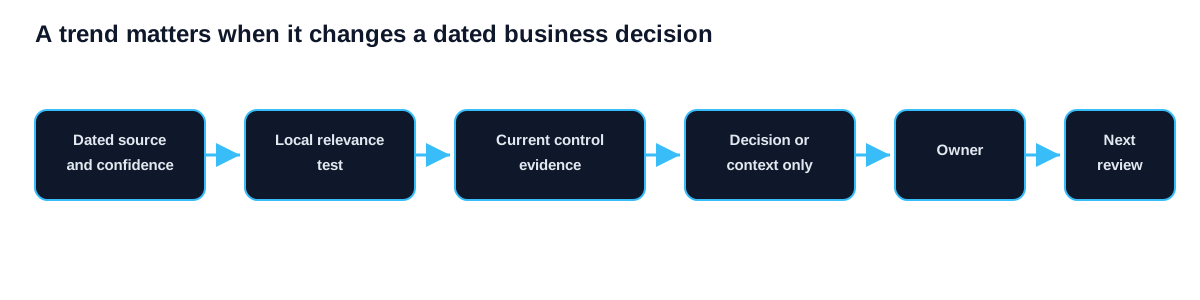
Limit each review to current sources and trends that could change a control, recovery assumption, or leadership decision. Record them through this cycle:
- Verify the source and observation period. Name the owner, scope and expected result before changing a control.
- Test relevance to local technology. Record exceptions and dependencies instead of treating partial coverage as complete.
- Record an act, monitor or dismiss decision. Preserve the evidence and assign follow-up work with a retest date.
Evidence to retain
- Publisher and method should show the current scope rather than a planned future state.
- Affected local asset should identify the person or system that produced the record.
- Current control evidence should include the date, limitation and unresolved exception.
- Owner and review trigger should connect the technical result to the affected business service.
Evidence for trend-review ages. Review it after a major platform, supplier, identity, policy or staffing change. If the environment no longer matches the tested scope, mark the prior result as historical and schedule a new check.
Review questions
- Is this observed or predicted?
- Does it affect our systems?
- What control should detect it?
- What evidence supports the decision?
- When will it be reviewed?
If an observation changes no decision, keep it as context rather than creating work. For actionable changes, record the affected service, evidence, owner, and review date. The ransomware protection guide supplies the stable control model against which dated changes can be assessed.
Archive superseded sources and explain why a prior conclusion changed. That history helps reviewers separate a genuine threat shift from a change in reporting method, sample, or terminology.
Update the small-business ransomware response plan when a verified trend changes evidence, communication or containment decisions.
Maintain a dated threat decision register
A short register prevents trend research from becoming an unowned collection of headlines. For each observation, record the source date, affected technology or business service, current exposure, existing control, evidence reviewed, decision, owner, and next review date. Mark the item as observed in the environment, relevant but not observed, or not applicable with a reason.
Review the register with technology, procurement, continuity, privacy, and leadership. A supplier-access trend may belong to procurement and identity owners, while a data-theft pressure trend may change legal contacts and communication exercises. Close items when the exposure is removed or the required test passes. Keep superseded reports as historical context so the next reviewer can see why a decision changed. This method turns current reporting into accountable work without pretending that a public trend predicts the next event at one business.