Ransomware for Legal and Accounting Firms
Protect deadline-driven client work and confidential information with practical ransomware controls for legal, accounting, and professional-services firms.
To discuss how Ransomware in Professional Services (Legal & Accounting) applies to your systems and responsibilities, contact QuantM Technologies for a scoped conversation.
Law and accounting firms hold client files, financial records, tax information, transaction documents, and confidential communications. Ransomware can interrupt deadline-driven work and may expose information subject to Canadian privacy law, professional duties, contracts, or court requirements. The applicable obligations depend on the firm, client, information, and jurisdiction, so counsel and the relevant professional guidance should shape the response.
Professional-services risk priorities
- Stolen confidential information can add extortion pressure even when systems can be restored.
- Deadlines, client permissions, privacy duties, professional rules, and contracts may all affect the response.
- The firm needs alternate work and communication methods that preserve confidentiality.
- Counsel must determine notification and reporting duties from the facts and applicable jurisdiction.
Why client work changes the response
Professional-services firms depend on timely access to client files, correspondence, calendars, research, billing, and specialist systems. Ransomware can stop that work while also creating uncertainty about whether confidential information was accessed. A response therefore has to coordinate technical containment with client deadlines, records duties, privacy assessment, insurance, and approved communication.
The firm should identify which matters or engagements cannot tolerate delay and which alternate procedures remain appropriate when normal systems are unavailable. A workaround that exposes client information or bypasses required approval is not a successful continuity measure.
Professional-services risks to account for
Why professional services firms are targeted. Law firms and accounting practices are data-rich environments containing the most sensitive information their clients possess: legal strategies, financial statements, tax records, merger documents, intellectual property filings, and privileged communications. This data is extraordinarily valuable for double extortion, the threat of publishing client financial records or legal case files is far more damaging than publishing a manufacturer's inventory data.
Regulatory and professional obligations. Canadian privacy law, provincial requirements, professional rules, court orders, engagement terms, and client contracts may apply. The answer depends on the firm, information, location, sector, and facts of the incident. Keep current contacts for privacy counsel and relevant professional bodies so qualified advice is available before a deadline is missed.
Liability and insurance. An incident may lead to client claims or insurance questions, but coverage and liability are policy-specific and fact-specific. Preserve the policy, application, endorsements, notices, consent requirements, control evidence, and incident chronology for counsel and the broker.
Client and authority communications. Do not assume every encrypted record creates the same notice. Counsel should assess affected information, evidence of access, risk, contractual clauses, professional duties, and applicable privacy law. Prepare contact routes and approved message ownership in advance, while keeping unconfirmed attacker claims separate from established facts.
Protection strategies for professional services include access controls tied to current matters, strong authentication, managed devices, monitored document and identity systems, restricted supplier access, protected backups, tested restoration, and a response plan that includes client-work priorities. Encryption helps protect information, but key access, endpoint compromise, permissions, exports, and active sessions still need attention.
Frequently Asked Questions
Are law firms required to notify clients of ransomware attacks?
The answer depends on applicable privacy law, professional duties, contracts, court requirements, affected information, and the incident facts. A Canadian firm should preserve evidence and obtain advice from qualified counsel and the relevant professional body. Do not use a general article as the notification decision for a live incident.
What should an accounting firm protect first?
Start with identity, email, client portals, tax and financial records, document storage, remote support, backups, and the systems that control deadlines and filings. Confirm which requirements apply to the firm's Canadian jurisdiction, professional designation, contracts, and client base. Assign evidence and recovery tests to each important service rather than relying on a generic control list.
Protect client work, deadlines, and confidentiality
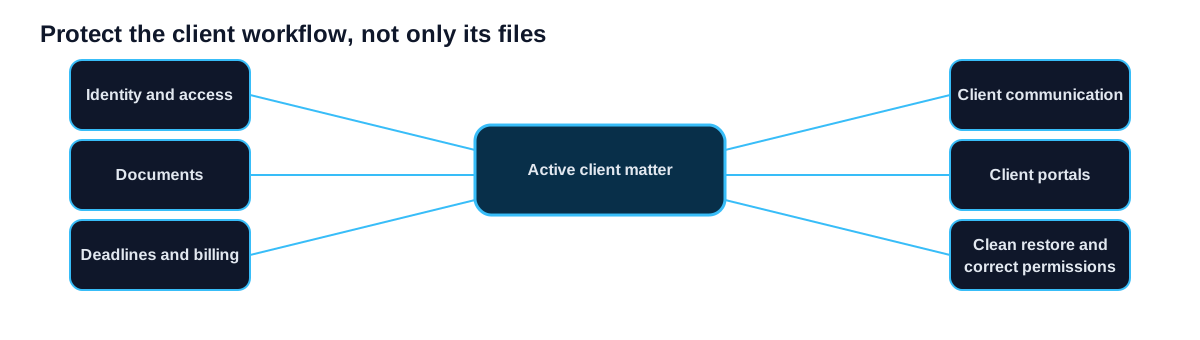
Professional-services firms should organize ransomware work around active matters, deadlines, client communications, and confidentiality. Map document management, email, identity, time and billing, client portals, remote work, and vendor access to those obligations. The review then shows which interruption needs a workaround and which access path needs stronger control.
Establish ownership and evidence
Firm leadership should connect matter owners, records management, IT, privacy counsel, and communications. Record which matters and deadlines depend on each system, who may approve alternate handling, how client instructions are preserved, and which confidential records require special treatment. Keep permissions and recovery evidence with the tested workflow.
Set the assessment boundary before testing. At minimum, include critical client deadlines and approved alternate work methods. Dependencies deserve the same attention as the main application. A service may be technically restored yet remain unusable because identity, DNS, network access, encryption keys, or a third-party connection is unavailable.
Measure the result without inventing precision
Test whether a representative active matter can be restored with its permissions, version history, deadline information, and approved users intact. Also time the alternate client-contact route and confirm that staff can record work when the main document or billing system is unavailable.
The firm should also test how conflicts, retention requirements, legal holds, delegated access, and departing staff affect the restored matter before declaring the workflow usable.
Source and next step
- Canadian Bar Association ransomware guidance
- Canadian Centre for Cyber Security, Ransomware threat outlook 2025 to 2027
- PIPEDA section 10.1
- NIST ransomware guidance for small businesses
Protect matters, deadlines and client confidence
A professional-services firm should organize ransomware planning around active client work. The review needs to identify which matters have fixed deadlines, where privileged or confidential records reside, how remote staff authenticate, and how the firm would communicate if email and document management were unavailable.
Use a representative active matter from intake through billing and archival as the working example. Ask the firm operations and privacy lead to map document management, email, identity, client portals, timekeeping and third-party experts, then follow the example through normal operation, disruption and recovery. The review should reveal where access, evidence or authority changes hands.
| Point in the scenario | Required evidence | Decision risk |
|---|---|---|
| Client work | Matter owner, deadlines, data classification and alternate procedure | Technical recovery ignores a filing or delivery date |
| Confidentiality | Access groups, external shares and audit records | Inherited permissions expose unrelated matters |
| Remote practice | Managed devices, MFA, session controls and support verification | A fake support request can trigger an account reset |
| Client notice | Contract terms, counsel decision and approved communication route | Staff improvise messages before scope is understood |
Finish by asking the team to restore the matter into a clean environment and verify permissions, versions, audit history and required communications. Preserve the result and assign each gap to the person who can change the system or procedure. The next exercise should confirm that the gap was corrected rather than introducing a new scoring scheme.
Readers can continue with the Canadian small-business ransomware guide, response roles and decision authority, and role-based employee exercises. Each destination answers a different operational question and supports the hub-and-spoke structure.
Put professional-services ransomware planning into operation
Select one representative client matter and test how the firm would preserve access, confidentiality, deadlines, and communication. Work through this sequence:
- Identify deadline-driven client work. Name the owner, scope and expected result before changing a control.
- Review matter permissions and remote access. Record exceptions and dependencies instead of treating partial coverage as complete.
- Test alternate work and clean restoration. Preserve the evidence and assign follow-up work with a retest date.
Evidence to retain
- Active deadline register should show the current scope rather than a planned future state.
- Matter access groups should identify the person or system that produced the record.
- Client notice clauses should include the date, limitation and unresolved exception.
- Restored version and audit history should connect the technical result to the affected business service.
Evidence for professional-services ages. Review it after a major platform, supplier, identity, policy or staffing change. If the environment no longer matches the tested scope, mark the prior result as historical and schedule a new check.
Review questions
- Which deadlines cannot move?
- Where are privileged files stored?
- Can staff work without email?
- Who approves client notice?
- How are restored permissions checked?
Assign each gap to the matter, records, technology, privacy, or communication owner who can correct it. The retest should confirm access and permissions for the same representative workflow. Refer to the ransomware protection guide for the controls shared with other small businesses.
Record any client-specific instruction or professional obligation that changes the tested workflow, and have the appropriate professional review that decision.
Reconcile client work after systems return
Recovery is not complete when the document platform opens. Matter owners need to confirm versions, permissions, external shares, deadlines, approvals, billing entries, and communications created during the outage. Records captured through a manual workaround must be entered into the restored system without overwriting newer work or creating duplicate instructions.
Choose one active engagement and write the reconciliation steps before an incident. Identify who can approve the authoritative version, how confidential paper or alternate-platform records will be transferred, and which client communications require review. During a test, preserve the before-and-after record and note any step that depends on memory or one person. This makes continuity and recovery part of the same client-service process while keeping legal and professional decisions with the qualified people responsible for them.