MITRE ATLAS: How to Use the AI Threat Knowledge Base
Use MITRE ATLAS to turn realistic AI attack paths into practical testing, monitoring, and response controls.
MITRE ATLAS is a knowledge base of adversary tactics and techniques against AI-enabled systems. It is informed by real-world observations and realistic demonstrations from red teams and security groups.
Security teams can use ATLAS to give AI threats a common structure, connect plausible attack paths to controls, and improve testing and monitoring.
What ATLAS contains
The official ATLAS site provides:
- tactics that describe an adversary's objective
- techniques and sub-techniques that describe how an objective may be achieved
- mitigations
- case studies
- a matrix for exploring attack paths
- data that teams can use in their own tools and analysis
MITRE describes ATLAS as a living, globally accessible knowledge base covering threats to AI-enabled systems. MITRE ATLAS
It includes predictive, generative, agentic, and enterprise AI considerations. Because the knowledge base evolves, teams should work from the current official version rather than a copied static list.
Where ATLAS fits
ATLAS is not a certification and does not prove that an AI system is secure or compliant. It is a threat-informed reference.
Use it alongside:
- an inventory of AI systems
- business impact and data classification
- architecture and data-flow diagrams
- risk assessment
- security testing
- logging and detection design
- incident response
The framework helps teams ask better attack questions. The organization still has to decide which scenarios apply and what evidence is sufficient.
Four practical uses
| ATLAS use | Business question | Evidence to retain |
|---|---|---|
| Threat modelling | Which attack paths plausibly apply? | Selected techniques and affected assets |
| Security testing | Do controls hold under realistic conditions? | Test case and result |
| Monitoring | Which signals reveal the behaviour? | Required logs and alert owner |
| Incident response | Can the team describe and investigate it? | Timeline, evidence, and follow-up |
1. Threat modelling
Map the system's data sources, models, prompts, identities, tools, outputs, and users. Use ATLAS techniques to identify how an attacker could gain access, manipulate inputs, evade controls, collect information, or cause impact.
2. Security testing
Turn relevant techniques into test cases. Test the full application, not only the model. Include retrieval, files, APIs, tool permissions, approval gates, and downstream systems.
MITRE and Microsoft expanded ATLAS to address attack pathways in generative AI systems. MITRE
3. Monitoring
Identify which logs and alerts would reveal the selected techniques. Examples may include unusual prompt patterns, repeated policy bypass attempts, unexpected retrieval, abnormal tool use, or changes to trusted data.
4. Incident response
Use ATLAS terminology to describe observed behaviour, organize evidence, identify related techniques, and communicate findings across AI and security teams.
A lightweight adoption process
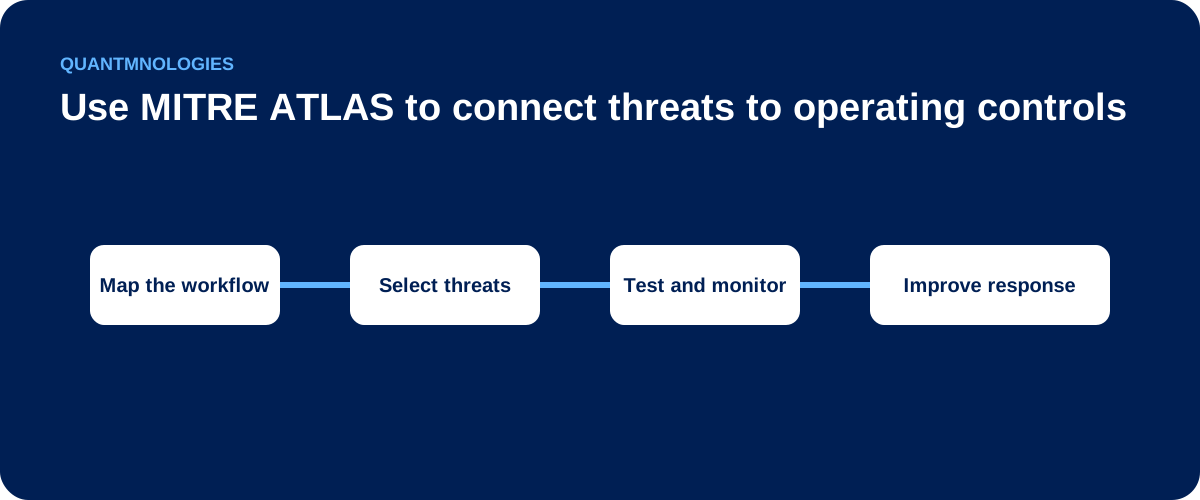
- Select one material AI use case.
- Map its assets, data, users, trust boundaries, and actions.
- Choose the ATLAS tactics and techniques that plausibly apply.
- Record existing preventive, detective, and responsive controls.
- Convert the highest-priority gaps into tests and monitoring requirements.
- Assign owners and retest after material changes.
The official ATLAS data repository makes tactics, techniques, and case-study information available for integration and analysis. GitHub
Questions for leadership
- Which AI systems could expose sensitive data or take business actions?
- Have those systems been mapped to realistic adversary behaviour?
- Which techniques can existing security controls detect?
- Are AI-specific scenarios included in testing and incident exercises?
- Who keeps the mapping current as ATLAS and the system change?
MITRE ATLAS is most useful when it moves from reference material into the operating security process. Start with a real use case, select relevant techniques, and connect them to controls, tests, logs, and response ownership.
FAQ
Why does MITRE ATLAS matter to a business?
It matters when an AI system can influence sensitive data, client work, business decisions, or connected tools. The consequence of a failure should determine the depth of review, testing, and approval.
Who should own this control?
The business owner should be accountable for the use case and acceptable outcomes. IT or security should own the supporting access, monitoring, and response controls. A qualified reviewer should approve higher-consequence use.
What is the first practical step?
Choose one live AI workflow. Record its owner, data sources, permissions, expected outputs, approval points, and failure response. Test those controls before expanding access or automation.
Put this control into practice
Start with one AI workflow that handles sensitive, operational, or client information. Document its logging, alert ownership, and response procedures. Test the process with a normal request, an unsafe request, and an error case before expanding its use.
QuantM helps Canadian SMBs connect AI governance with identity, Microsoft 365, cybersecurity, and documented business controls. Start with a free AI readiness assessment to identify the first control gaps to address.